Dustin Hoffman is on the phone for you.

What is success? How do you define success? These are great questions. One afternoon, one of my fifth graders boldly stated that he would never be successful. I asked him why. He said he didn’t have a special talent or money so he just couldn’t be a success. The class stopped what we were doing and headed to the carpet (that is our “thinkin’ spot”). While on the carpet, we talked about what makes a person successful and how do you determine success. We then listed people that we thought were successful. Several names popped out of their mouths. Most of the kids talked about actors, actresses, singers, and sports stars. “What about politicians or business people?” I asked. They decided that, yes, those people should be listed too. “What about people who can provide for their families but don’t have the recognition that famous people have?” I mentioned. We all agreed that those people should be considered successful as well. One student spoke up, “I wish we could just ask successful people what it takes to be successful and what they consider a success.” Ahh, a teaching opportunity!

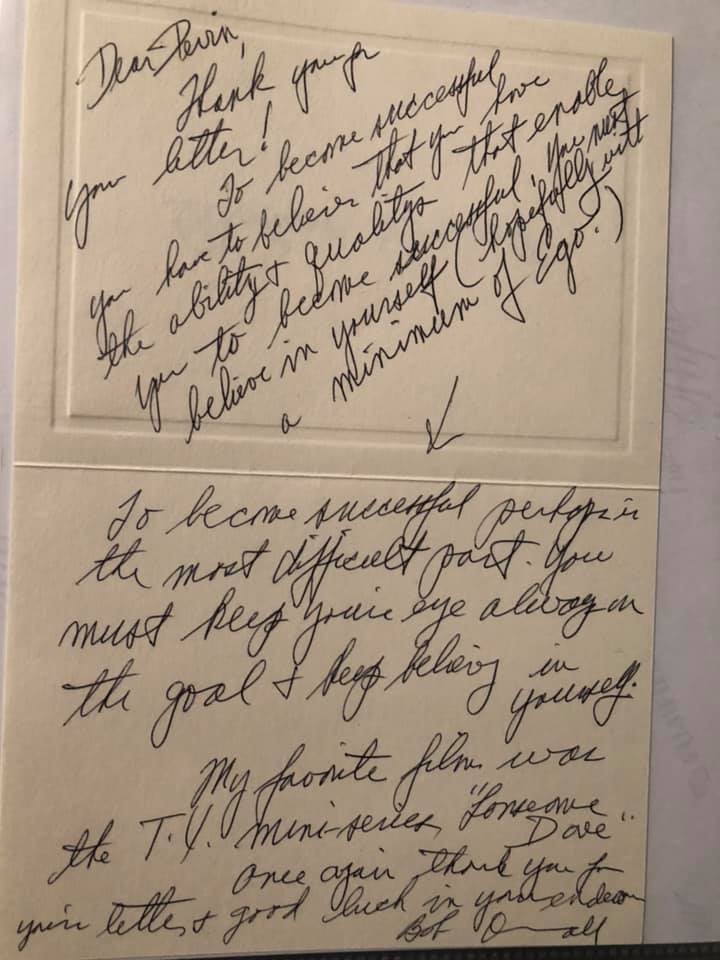
I asked the kids to go home, sit down with their parents, and list five people they think are successful. The following day we made a list. The list included actors like Roseanne, Matthew McConaughey, Jeff Foxworthy, Bob Newhart, Dustin Hoffman, Alec Baldwin, Kate Winslet, and Robert Duvall. The list also had political figures like George W. Bush, John McCain, and Tony Blair. On the whiteboard, we had Jay-Z, Pat Sajak, Dick Butkus, Bob Schieffer, Robin Roberts, and Warren Buffett. In total, we had roughly 30 names listed. Students were drawn randomly to pick a name from the board. It was now their job to study this person and learn all they could. While the students were busy studying their successful person, I started the task of finding out how to get in contact with them. This was no easy feat.

A few days after the students researched their successful person, I told them that they would be writing them a letter. I told them that they had to write about what they learned about their person and that it was important they ask the two questions that we discussed just days prior – what makes a person successful and how do you define success? The students got busy writing. After a few rough drafts, the students felt confident mailing them out. We were shocked as to what happened next!

A few weeks after the letters were mailed out, a Fed Ex guy came to my classroom door. He had an overnight delivery that had to be signed by one of my students. My student got up from his desk and signed for the package. It was a handwritten letter from his successful person as well as some memorabilia. The class was shocked! A few days later more letters started trickling in. All of the letters were hand written and answered all of their questions. Students started asking me if they could write back. “Absolutely!” I exclaimed! Soon, students started to become pen pals with these people! One student was flown down to Detroit to see their successful person perform at Fox Theatre. Another student wrote back and forth to their person a few times over the course of the school year. At one point, she mentioned her parents financial struggles. About three weeks later, the bank called her parents to say their mortgage had been paid in full! Not only were these kids learning about success, they were learning about decency as well. Every student received a personal response. Well, all except for one.

Nick patiently waited every day for the mail to come to the school. And, every day, a letter would not be addressed to him. His successful person was Dustin Hoffman. I tried to explain that Dustin Hoffman was extremely busy and maybe he should pick someone different. “No, ” he said. “I want to wait to see what happens.” After a few more weeks, Nick decided to give up. He really wanted to wait on Dustin Hoffman but also wanted to start building a personal correspondence with someone who would be willing to write back.

Two days after Nick started researching his next person, we were in the middle of math class when the intercom came on. “Mr. Hall, is Nick available?” the voice blared over the silver speaker. “He is in the middle of math right now. Can this wait?” I responded. “No,” she said with a chuckle. “It can’t. Dustin Hoffman is on the phone and would like to speak with Nick.” The class grew quiet and then we roared in excitement. Everyone in the class wanted to hear Dustin Hoffman. I told the office to put him on hold (seriously, put Dustin Hoffman on hold!?) and we rushed to the office. While we gathered around the only phone in the school that had a speaker, Nick calmly pressed the button. “Hello. This is Nick.” he said. “Hi Nick, this is Dustin Hoffman.” The class cheered! For FORTY-FIVE minutes, Nick and his classmates were able to ask Dustin Hoffman anything they wanted. He was amazing! He patiently answered all of their questions but, most important, he wanted to learn about Nick. He asked Nick all about his family, his town, and his interests. In fact, I don’t think Mr. Hoffman wanted to hang up. After saying their goodbyes, Nick hung up the phone, hugged his fellow classmates, and walked back to his class chatting about his experience.

I knew that Nick felt like a success that day.

Matthew McCoaughey’s letter
Bob Newhart
Stan and Jan Berenstain
Alec Baldwin
Jeff Foxworthy
Kate Winslet
Robert Duvall
Pat Sajak
Roseanne

Did Somebody Call a Doctor?

Here is a fun idea for when you want to do a test review. Go to your local hospital and ask them if you can have some surgical scrubs. Tell them why and they will usually donate. Prior to the students coming in, use bulletin board paper to cut out life size bodies. Write on the bodies the problems you want them to solve. Put them all over the body. Then print the answers on sheets of computer paper. Put the “body” on a table like it is ready for surgery. Separate the operating tables with sheets hanging from the ceiling. At the end of each operating table, put a desk and have a cafeteria tray sitting on it. On the tray, have some small scissors, a glue stick, and a bunch of tweezers.
Then go on YouTube and find a heart monitor sound effect.
When students arrive at school, they aren’t allowed in the room because of the “Warning: Sterile Area” sign. Students are taken to another room where they are dressed in scrubs (masks, hairnets, gloves, booties, and gown) and go to their assigned surgical station. Prior to arrival, students are handed a clipboard with information about the patient and what they need to do.
When they get to their station, they start “performing surgery”. They read the question on the body, find the answer on the computer sheet, cut out the answer and use the tweezers to place the answer on the body.
Along the way, the patient may flat line and they have to get it to revive (this part is just for fun).
When the students are finished, I check their answers to see if the patient survived.
The best part is they get to call each other doctor!

Hatchet Meets the Hall-Stars!

As a teacher, I have found that the most engaging and impactful lessons have come from necessity. Whether it be establishing a classroom economic system because a student didn’t know how to manage his own money to learning simple table manners – it all comes from something you notice and want to make better.

A lot of the activities I have come up with are based on that premise – what prior knowledge do my students not have and how can I connect it in a way to make it meaningful.

One of the best examples of this happened a few years back. My students were reading the book Hatchet (If you haven’t read it, stop reading this blog right now and buy a copy). If you aren’t familiar with this book, it is about a boy who is flying in a small Cessna plane to go visit his dad. During the flight, the only other person on the plane, the pilot, suffers a heart attack. Brian now must take control of the plane. Oh, and he has never flown a plane before!

There are many exciting chapters in this book but the way Gary Paulsen details Brian’s emotions as he tries to avoid death is powerful. It is my favorite part of the book.

When it came time to read the heart attack chapter, I had everyone get out their books and follow along as I read. Now, I try to make books come alive for students. So, I did my best to act out this dramatic scene. I stood on a student’s desk and pretended I was Brian trying to get a better grasp on his current situation. I read:

“Don’t know, kid…” The pilot’s words were a hiss, barely audible. “Bad aches here. Bad aches. Thought it was something I ate but…” He stopped as a fresh spasm of pain hit him. Even Brian could see how bad it was—the pain drove the pilot back into the seat, back and down. “I’ve never had anything like this…” The pilot reached for the switch on his mike cord, his hand coming up in a small arc from his stomach, and he flipped the switch and said, “This is flight four six…” And now a jolt took him like a hammer blow, so forcefully that he seemed to crush back into the seat, and Brian reached for him, could not understand at first what it was, could not know. And then knew. Brian knew. The pilot’s mouth went rigid, he swore and jerked a short series of slams into the seat, holding his shoulder now. Swore and hissed, “Chest! Oh God, my chest is coming apart!” Brian knew now. The pilot was having a heart attack. Brian had been in the shopping mall with his mother when a man in front of Paisley’s store had suffered a heart attack. He had gone down and screamed about his chest. An old man. Much older than the pilot. Brian knew. The pilot was having a heart attack and even as the knowledge came to Brian he saw the pilot slam into the seat one more time, one more awful time he slammed back into the seat and his right leg jerked, pulling the plane to the side in a sudden twist and his head fell forward and spit came. Spit came from the comers of his mouth and his legs contracted up, up into the seat, and his eyes rolled back in his head until there was only white. Only white for his eyes and the smell became worse, filled the cockpit, and all of it so fast, so incredibly fast that Brian’s mind could not take it in at first. Could only see it in stages. The pilot had been talking, just a moment ago, complaining of the pain. He had been talking. Then the jolts had come. The jolts that took the pilot back had come, and now Brian sat and there was a strange feeling of silence in the thrumming roar of the engine—a strange feeling of silence and being alone. Brian was stopped. He was stopped. Inside he was stopped. He could not think past what he saw, what he felt. All was stopped. The very core of him, the very center of Brian Robeson was stopped and stricken with a white flash of horror, a terror so intense that his breathing, his thinking, and nearly his heart had stopped. Stopped. Seconds passed, seconds that became all of his life, and he began to know what he was seeing, began to understand what he saw and that was worse, so much worse that he wanted to make his mind freeze again. He was sitting in a bush plane roaring seven thousand feet above the northern wilderness with a pilot who had suffered a massive heart attack and who was either dead or in something close to a coma. He was alone. In the roaring plane with no pilot he was alone. Alone.

I looked around the room anticipating the students to say, “Read more! Come on, Mr. Hall!”. But no one did. They just stared at me. I stood there for a moment and then asked, “Wouldn’t you be scared?” No one said a thing.

Now, a little background about the town in which I teach. I teach in a rural, blue collar town. A lot of students don’t travel outside the town and have the experiences that, say, a student living in a wealthy environment would have.

I hopped off the table and asked, “How many of you have ever been in a plane before?” Two of my twenty-four students raised their hands. I knew why. Flying is a luxury and one that we just don’t need in my community. Something had to be done. That weekend I went to the local community airport. When I entered, there was an older man that was standing by the vending machines. I walked up to him and asked, “Do you know if there is a Cessna plane around here?” He turned and in his gruff voice said, “Yeah, I got one.” I told him what my students were reading and how they just couldn’t seem to connect the book to any personal experiences. He asked me to follow him as we walked across the airfield to a smaller hanger. Surprisingly, there before me was the identical Cessna plane that Paulsen used in his story! The pilot and I concocted a plan for what was to happen next.

On the following Monday, I called my superintendent and told him I wanted to take my students on a plane ride. I explained how they had trouble picturing what the main character was experiencing and this would provide some prior knowledge. The superintendent said he would need to contact the lawyers and insurance company to see if it was even possible. About three hours later, I receive a call. With a long, heavy sigh, the superintendent told me that he couldn’t make it happen. However, he said, the school isn’t responsible if they randomly showed up at the airport on a Saturday. I took the suggestion and called the parents. I wanted to make sure the students were not aware of what was to take place.

The following Saturday, the pilot and I sat at the airport as students started to trickle in. They all had confused looks on their face. Finally, after the last student arrived, I said to them, “So, we had some trouble with reading Hatchet. None of you seemed to understand the magnitude of what Brian was facing when he was in that plane. Well, today you will. Each of you will be going up in this plane and flying over Lake Huron. This is the same type of plane that Brian was in.” The students looked shocked! Some even looked hesitant. My classroom motto is Carpe Diem. The students use it all the time. We all agreed that Carpe Diem was what we needed to hear for this experience.

One at a time, the students each went up in the sky. While in the sky, the pilot let go and let the students fly. He talked about the controls and how a novice pilot would have difficulty with managing to control the plane. As each student landed, they came out with a better appreciation of what Brian experienced.

After the last student returned and the sun was setting, all of the students gathered around and asked me to go up. I hate heights. I hate planes. However, when the students started chanting Carpe Diem, I had no choice. I went up.

The following Monday, we reread the plane passage and students were on the edge of their seats. They felt what Brian felt. You could see their fear and anxiety as the story went on. They had a better grasp of this amazing book and a deeper appreciation for his experience. Carpe Diem!

Design a site like this with WordPress.com
Get started