Four Houses – One Family

I spend a great deal of my school year focusing on teaching students to care and respect each other. I do this in multiple ways. Yes, it takes time away from the required curriculum but it is so important to the success of my class. By the end of the first month, students learn to trust and care for each other. They give shout-outs to the shy student or the kid who “held it together” instead of melting down.

If you have read any of my other blog posts, you will know that I have my classroom arranged in houses. Six students form a house. They have a house chant, name, crest, and mascot. They also sit together ALL. YEAR. LONG. While many people move kids based on behavioral needs, I force the six kids to problem solve and learn how to work together. It takes time but it does work.

Throughout the year, houses earn points for doing different things. Their goal is to earn the most points so they can win the house cup. The house cup gives them bragging rights throughout the next marking period. The house cup is the ultimate goal! So, it may not surprise you that houses WANT those points as they WANT to win. However, I also have a class motto: Four Houses – One Family. It doesn’t matter what house you are in, you still must be kind and supportive to other houses. With that said, here is what happened today.

The students were given back their graded math tests. After each test, we rewrite the questions and answer them. It’s a nice way for them to review and catch their mistakes. When I call on students to answer a question, they must stand and restate the question and give the answer. If they do that, their house earns five points. I randomly pick students from a bucket so it is fair for all houses to be selected.

Three of my houses – Waibu, Fidele, and Busara kept getting selected and were racking up the points. Valeroso, the fourth house, was not. For some reason, the housemates names were not getting picked out of the bucket. At one point, the other houses were cheering on Valeroso in hopes of one of them being selected. We had other students pick from the bucket with no success. We even did the juju finger jiggle to project good juju on them – no luck. Finally, after the other three houses had earned well over 50 points (with Valeroso only having 5 points), the class asked me to step outside. They needed a class meeting and I didn’t need to be there. After five minutes, I was invited back into the classroom. Moving on to the next problem, I asked this question:
Me: “Busara, what is 13+2?”
A member of Busara replied, “13+2 = 28.”
I shook my head and was confused as to why they would guess that. I pulled another stick.
Me: “Fidele, what is 13+2?”
A member of Fidele replied, “13+ 2 = 34.”

Finally, I pulled a Valeroso name.

Me: “Valeroso, what is 13+2?”
A member of Valeroso replied, “13+2 = 15.”

The whole class erupted in joy. I went back to the test. Every time a house was called that wasn’t Valeroso, the students answered incorrectly. When Valeroso was called on, they got it correct and everyone cheered. I finally caught on to what they were doing. The three houses were helping the one house that needed the points. They realized that, by answering incorrectly, that I would eventually pick a house member from Valeroso. It was amazing to see. They made me so proud.

Four Houses – One Family.

The Young Americans

I’d like to start off by saying I’m sorry for not blogging as much as I should. I have been really busy connecting with my students and coming up with ways to bond with each of them. I have a really challenging class this year but I love them to death. I always find the hardest kids to reach are the ones that need the most love. I have spent the better part of the month instilling in each of them their self worth and building up confidence in those that, otherwise, lost it years ago. Very few have trust in adults so it continues to be important to me that I build that trust with each of them. This leads me to the Young Americans

If you have not heard of the Young Americans, stop reading this blog and do a Google search. They are a group of young and talented college students who go to an arts college in southern California. They travel the world to inspire students through the arts. You can have them come to your town and put on a workshop for your school. Simply put, they are amazing. My district was fortunate to have them come and do a three day camp. Prior to the 40 Young Americans coming, they sent a forward team of four Young Americans to our school. They were there to talk about the upcoming camp, sing some songs, and answer any questions the kids had.

After the assembly, I brought my class back to our room and sat them on the carpet (yes, we still meet on the carpet. The carpet is a place where we share, laugh, and cry). I asked them how many were interested in going to the Young Americans camp. More than half of my class raised their hands. I told them that the cost was $59 a student. Suddenly, all of their hands went down. I saw their excitement fade as they realized their families would not be able to carve out $59 when they live from paycheck to paycheck. As I looked around the circle at their disappointed faces, I exclaimed, “If you want to go, I’ll pay for it!” Luckily, my wife is a teacher and understands the crazy things I do. Suddenly, their faces lit up, tears flowed down their faces, and cheers erupted throughout the room.

Thirteen of my students signed up to attend. Thirteen kids with different backgrounds. The shy kids, the former bullies, the musical kids, and the outcasts all participated in this workshop. By the end of the first day of camp, the students came back to my room full of joy. They sang the songs they learned that day. They did the dance moves that they would soon use to show the hundreds of people that would come to watch. They did what I hoped they would do – bond.

The evening of the performance, the kids kept coming up to me and thanking me for giving them that experience. When the show began, I sat in awe when I watched the shy kid sing a solo, the bully find his voice and sing with such joy and heart, and the quirky kid who finally found a place where she could shine.

People often ask me how I get a class to bond. It’s really all about trust and believing in the students you have. Since that camp, the class cheers each other on when a student gets a correct answer, consoles a kid who is having a bad day, and yells, “Good try” when a student is bold enough to attempt to answer a difficult question but gets it wrong. My class is more than a group of kids with different backgrounds. They are a family.

101 Dalmatians And Styx

Quite a few years ago, I taught third grade. I loved teaching third because third graders still love coming to school and think everything you do is just amazing. They haven’t quite hit that social/emotional peak that most fifth graders reach. The hormones haven’t started and they aren’t as moody. Don’t get me wrong – fifth grade is wonderful. Third graders are just,well, less smelly.

In March, I announced to my third graders that I was taking them to Michigan State University to the Wharton Center (an amazing performing arts center). We were going to see 101 Dalmatians on Broadway. In addition, one of my former students was going to give them a college tour. The kids were all excited! But, they knew my policy on field trips so they knew they had a lot of preparing to do. My field trip philosophy is simple – kids should learn everything they can about the place they are visiting so, when they get there, they can enjoy seeing everything they have learned.

Students started studying the history of MSU. They learned the names of the different dorms and the enrollment numbers. We researched the cast of the 101 Dalmatians and learned fun facts about each actor and actress. Along the way, the students learned that the music from the show was written by Dennis DeYoung, a founding member of the band Styx. With that knowledge, we began learning about Dennis DeYoung and I began playing Styx songs throughout the day. One of my students, Thomas, became infatuated with Styx. He LOVED their music and even asked his parents for a Styx CD for Christmas!

In May, we boarded the bus and headed to East Lansing. When we arrived, we were met by my former student (a current MSU student). She got on the bus and, as the bus driver drove us around, started showing us all the different parts of the campus. For many of my students, it was the first time they had ever stepped foot on a college campus. We were able to go in to her dorm room and see what it looked like. The kids were even allowed to sit in on a college class. They were amazed at the nearly four hundred college students that surrounded them in this massive lecture hall.

Before the show, I surprised them with dinner at one of MSU’s cafeterias. The kids felt like big shots as they ate with the older kids. They were shocked at the many different food options and, of course, the dessert bar. After we ate, we headed to the Wharton Center to see the show. What they didn’t know is that I had planned a meet and greet with the cast for after the show. The cast consisted of 10-11 year olds – wonderful performers who were so talented.

As the lights went down and the curtain came up, I kept my eyes on the faces of my students. They were in awe of the entire performance. They were enthralled with the lights and music. One of my students leaned over to me and whispered, “Mr. Hall, it’s like a movie come to life!”. When the lights came on, the students were bummed. I told them it was intermission and that the show was only half way over. They all got up, stretched, and headed to the closest bathroom. As we were heading to the concession area, Thomas stopped dead in his tracks. I asked him if everything was okay. He pointed to an older gentleman leaning against the wall. I looked over and didn’t recognize the man. I asked Thomas if he knew him. Thomas quietly said, “That’s Dennis DeYoung of Styx.” I told him he needed to go over there and talk to him. “Carpe Diem!” I said. Thomas took a couple of deep breaths and headed his way. I’ll never forget the conversation:
Thomas (with his hand sticking out for a handshake): Hi Mr. DeYoung. My name is Thomas.
Dennis DeYoung (shaking his hand): It’s nice to meet you, Thomas.
Thomas: I love your music. My favorite song is Renegade. I know you wrote that song so thank you for that.
Dennis (slightly taken aback): You are welcome.
Thomas: Umm, I do have a question for you though. My class researched some things about Styx and about you in particular. I was wondering why you stopped being an elementary music teacher.
Dennis: How old are you??
Thomas: Eight.
Dennis: Well, I am really impressed with what you know. I quit teaching because I got paid a lot more being in a band.
Thomas: Okay. It was great meeting you.

Thomas then turned and walked away. I still remember Dennis’ face as he stared at the back of Thomas’ head. It was priceless.

Once the show started back up, the kids moved back to the edge of their seats and the excitement continued. When the show ended, the students stood and cheered. Many were sad that it had come to an end. Just as we were about to leave, an usher came up to us and asked the class to follow her. With confusion on their faces, they followed along and were surprised to be brought into the green room. After a couple of minutes of standing around, the young cast came in. It was like the students saw the President of the United States. They started chatting with the cast, getting autographs and taking pictures. What was most amazing was seeing that the cast stopped being performers and started being kids again. My kids danced alongside the kid cast. They talked about their favorite music and TV shows. It was so entertaining to watch. We stayed in that green room for close to an hour. When it was over, we boarded the bus to head home. I was surprised when, halfway through the trip, the students gave me an autographed poster of the show. They secretly went around and got the cast to all sign it. I still have it hanging in my classroom. It is a wonderful keepsake from a wonderful day!

Black Light Fun

I LOVE using black lights. Black lights make lessons so engaging. The kids love seeing how the room transforms when we turn off the lights and turn on the black lights. The best way to get black lights is from the Halloween Superstore right after Halloween. They practically give them away. The best part about using black lights is that it takes very little prep work. All I do is put bulletin board paper over the windows and plug in the lights. It’s that simple. The goal is to make sure you have as little natural light as possible when using the black lights. While I use them for many different activities, I wanted to share two of my favorite.

The first activity is called Secret Agent Spy Math. Here is how it works. In order to do this, you will need white yarn, white index cards, and white index cards. The day prior, I set up my classroom. I string white yarn all around my room. I cover my windows with black paper. Then I set up black lights around the exterior of the room. After all of that is set up, I have a bunch of different math word problems written on the white index cards. I make sure the index cards are numbered to match the paper that the student is going to get. When the students come to school the next day, they see a sign on the door that says, “TOP SECRET! MEET ME IN THE CAFETERIA!” When they rush to the cafeteria, they are handed the special agent letter. After students get on trench coats and detective hats, they grab a clipboard and a pencil and head to the room. When they arrive in the room, the black lights are already on and the yarn is lit up to look like laser beams. Students navigate through the “laser beams” to get to the math problem they have to solve. When they think they have the answer, they come to me to check to see if they are correct. 
It looks extremely dark and crowded in the attached picture. I promise you it is not. Students can see and, in all of the years I have done this, no one has gotten hurt. The kids really love this activity and it really tires them out trying to navigate around the beams!

My other favorite activity with laser beams is using it in writing. Again, I black out all of the natural lights and plug in the black lights. Once they are all on, the students are given a white sheet of paper. Using orange or yellow highlighters (their choice), they are to write a story. What is so neat about his activity is the black lights cause the highlighters to glow. So, when they are writing their stories, they see their writing shine! Last year, I taught a K-5 STEAM class and I did this activity with the kindergartners. They loved it! This is also a great activity for kids who don’t like to write. Change it up a bit (by adding the black lights) and, soon, your most reluctant writer will start writing. The picture below is a letter that a kindergartner wrote me. She loved doing black light writing. This is also a great example of what the highlighters look like when they are lit up by black lights.

Getting STEAM-Y in Reno

Each year, my father and I take an annual trip to Reno. It gives us a chance to get away and spend some quality time together. We always say that, when we are there, we want three Fs – food, fun, and fortune. There are three casinos that we stay at. Each casino offers different perks. One of the casinos, The Atlantis, is our favorite. Because of the annual trip, we usually get offered some perks – free room, free meals, and some free play. I also love playing there because you earn comp points. Every time you pull the handle on the slot machine or press a button to start a video poker hand, you earn five cents. So, if you play pennies, you actually make four cents every time you play a hand. Trust me. There is a reason why I am telling you this.

Last week, we spent four days at the Atlantis. We played quite a bit and had a lot of fun, some great food, but not much fortune. As we play, I always check to see how many comp points I have. Over the years, I have saved enough comp points that I had close to $100. When you earn comp points, you can spend them at the casino shops and restaurants. You can’t cash them out for actual money. After a few days of playing, I decided to check out the gift shop.

I am sure most of you are familiar with the Pringles challenge as well as the Save Fred challenge. They are both STEAM challenges that require teamwork. I planned on doing both of these activities during the first week of school. When I walk in to the gift shop, I spotted cans of Pringles! Success! I grabbed 12 cans. Looking around some more, I couldn’t believe it when I saw bags of gummy Lifesavers and gummy worms. Everything I needed to do these activities were in this store and didn’t cost me a thing. I took all of my supplies up to the counter. I really looked like I was holding the Ark of the Covenant. The cashier looked at the twelve cans of Pringles and six packages of various gummies and then looked back at me. “Mr. Eric,” she said. “I have a lot of questions.” I told her that I really enjoyed Pringles and that those types of gummies were my favorite (I could have really told her why I needed them but what fun would that be).

I proudly took my STEAM supplies and headed to my room. When I walked in, my dad gave me a bewildered look. I just said, “It’s for school.” He understood – all spouses and parents of teachers seem to get it. Now, I faced a different dilemma. How was I going to pack all of this in a suitcase and bring it home? I dumped everything out of my suitcase. I decided it was best to wrap a shirt around each can of Pringles. That way each can would get some extra support. Once each can was wrapped, I started placing the Pringles in the suitcase. I really want to take a moment to thank my parents for letting me spend hours playing Tetris. After thirty minutes, I was able to get all twelve cans in my suitcase and still have room for a toothbrush. Success!

When I got home from my trip, I proudly opened the suitcase to show my wife all of my treasures (Don’t worry – I got her a key chain). “It’s for school.” I told her. She understood. She is also a teacher so she is known to have done some crazy things for her students. I’ll have to tell you about the time she boiled a dead porcupine in our kitchen to get the quills. But that is another story. When I took each can out, I noticed something unusual. They sounded like they were all crunched up. I guess the air pressure in the plane was not a fan of Pringles. I gently shook each can. I could hear mostly crumbs. In fact, it sounded like a Sumo wrestler got a hold of them!

Oh well. I decided that I am still going to use the cans. Here is why. It makes for a great story. Imagine the students opening their cans to build their Pringles ring only to see a bunch of crumbs. This then becomes a great bonding exercise where I tell them about my adventure in getting the cans home. It really does make for a good story. I’ll tell you how it goes when we try the challenge.

Poetry Slams

I’m not going to lie to you. At one time, I hated teaching poetry. As much as I love Jack Prelutsky and Shel Silverstein, I just felt like kids imagined all poems had to rhyme and be funny or gross. I was blessed with having a teacher friend who reintroduced me to poetry. Do you have a teacher friend that just motivates you to do better and try harder? I do. In fact, my wife affectionately calls her my “work spouse”. We are always bouncing ideas off of each other. With her help, I came up with a poetry slam activity.

When it was time to teach poetry, I did have the students read Prelutsky and Silverstein. I wanted them to understand cadence and rhyme scheme. After they understood how to craft a poem. I wanted to take it further. One of my former students, Rakeem, is a poet. He goes by the name One Voice. He is an amazing poet. I reached out to Rakeem and asked him what I could do to change how students view poetry. His suggestion was a simple one – immerse them in good writing.

I wanted students to start to see that poetry wasn’t always funny. I wanted kids to know that poems represent what is going on in peoples’ souls. That it can be an instrument to help people understand. Sure, farts are funny, but having students read The Ballad of the Landlord by Langston Hughes connects them on a personal level. Soon, students started immersing themselves in other poets – Angelou, Ginsberg, Thomas, and Longfellow. Kids would check out books of poetry by Frost, Keats, and Yates. Soon, students started debating what each poem meant. This led to great conversations about how poems can be interpreted. Besides the fact that students were starting to read impactful poetry, I also noticed that their writing was becoming more personal – more defined. Kids were taking risks. No longer would I read:
I have a cat.
She wears a hat.
What do you think
About that.

Now I was reading:
As the wind whispers to me
through the cracks in my bedroom wall
I reach for the only friend I have –
the blanket that wraps her warmth
Around me.

It was amazing to witness. Kids would start sharing their poems at circle. They weren’t afraid to express themselves. On their own, students started researching the history behind poetry readings. They learned that in the 1960s, instead of clapping, people who snap their fingers in approval. This was because audience members didn’t want the police to hear that a poetry event was taking place because a lot of poems were anti-government.

What do you do when you start to see kids take initiative and start writing? Well, you showcase it of course. With the permission of the students, I invited the parents to our first ever poetry slam.

Prior to the slam, I had kids make posters promoting the event. Other students made invitations while some more students made programs to be given to guests. I had a decorating team whose job it was was to transform the classroom into a stage. With my help, the kids took apart the red carpet pallet runway and built a stage. They covered the pallet stage in black fabric. We found a microphone and stand from the music room and put that on stage as well. A month earlier, we had our Polar Express Day. I had a spotlight that we used for the front of the train. Students asked if they could use that to spotlight the student on stage. “Great idea!” I said.

One student suggested we contact a seasonal restaurant to see if we could borrow their pub tables and chairs. “Sure,” I said, “But you are going to have to call them.” A student found a contact number, called the owner, and explained what we wanted to do. With a little bit of persuasion, we were able to borrow all of their pub tables and chairs. After school, I met up with the owner and loaded a truck. The following day, the students moved their desks out of the way and set up the pub tables and chairs. They covered the tables with black bulletin board paper and put a battery operated candle on top (Man, I use those candles a lot!). We turned on our white Christmas lights that always hang on the ceiling, turned off the overhead lights, and turned on the spotlight and candles. Holy smokes! It did look like a poetry event! The kids were thrilled!

That night, families came to hear the children open their souls and read their poetry. Some were scared. Some were proud. Regardless of how they did, guests snapped their fingers in approval. That night I watched as kids showed what they were capable of doing. Isn’t that what teaching is about?

This is my former student, Rakeem. He is my hero.

Figurative Language Fashion Show

A few years ago, I was driving downtown and noticed a sign that said, “Free Pallets – Take What You Want”. I quickly pulled over. I didn’t NEED pallets but, as all teachers know, I was sure I was going to use them for something. I opened up the back of my SUV and shoved them in. When I got home, my wife, also an elementary teacher, asked me what I was doing. “I think I could use these for school.” I said. She didn’t question it and even helped me unload them!

Fast forward a year. The pallets were still sitting in my garage and I still didn’t know what to do with them. My class was just finishing a unit on figurative language and I wanted to do something fun as a culminating activity. That’s when I thought about the pallets that had been stacked in my garage. If I somehow attached the pallets together, I could make a runway. Students could then strut down the runway while other students described the models’ outfits using different types of figurative language!

When I got home from school, I laid the eight pallets side-by-side. My wife came in with a puzzled expression on her face. “It’s for a figurative language fashion show,” I muttered. She just nodded and went back inside.

I wasn’t quite sure how this was going to work so I called my neighbor. He is an eighty year old retiree who does woodworking on the side. He drove his lawnmower over (as he has arthritic knees) and listened as I explained what I wanted to do. Now, I have known this kind man for almost ten years. He doesn’t even question why I do what I do. He just puts my vision into action. He quickly figured out a way to fashion them all straight across so that I could put them in the back of his truck and take them to school. Once the eight pallets were laid in a straight line and supported enough that both of us could put it in his truck, I decided I wanted to fancy up my newly constructed runway. I had some leftover red fabric from the time I did a red carpet event at Back-To-School night. I unrolled the fabric and stapled it to the pallets. I stepped back. “Not bad!” I thought. Then, I had some white lights remaining from my Polar Express unit so I used a staple gun to put lights around the base of the runway. It actually looked like a runway. I decided to test it out. I stood on one end and started sashaying down the aisle. My wife walked in to drop off some recycling, looked at me, shook her head, and went back inside. Seriously, I get that look a lot.

The following day, I jumped up on my table (that usually gets the kids’ attention) and announced that we were going to have a fashion show. The kids looked confused. I told them that, tomorrow, they had to come to school in their craziest outfits. I would then pair students up. As one student walked down the runway (again, I started sashaying), that student’s partner will be describing the outfit using as much figurative language he/she could muster. The kids got excited and started talking about all of the crazy things they would be wearing the next day. “Can we wear floppy hats?” asked one student. “Absolutely!” I said. “What about those oversize sunglasses?” asked another. “You bet!” I replied. The kids were pumped and so was I.

That night, my wife and I loaded the runway into the back of the neighbor’s truck and drove it to school. Once there, I moved the students desks to the back of the room and sat chairs going up and down the outskirts of the runway. It really looked like a fashion show! With the pallets making the runway slightly raised, it focused students’ attention on the model. I added a few finishing touches. I always have strobe lights (note: make sure students aren’t sensitive to them). I grabbed six from my cabinet and put three on each side. I set them so it looked like photographers were flashing their cameras as the model walked down the runway. Of course, there is nothing better at a fashion show than the music. I downloaded some runway music as an added bonus. I was set.

The next day , the students walked in wearing some of the craziest outfits I had ever seen! I forgot to tell the principal about my idea so I had to explain to him that this was purely for educational purposes only. Like my wife, he just nodded his head, sipped his coffee, and walked away.

When students arrived at my door, there was a note instructing them to go to the multipurpose room. That room is usually vacant first thing in the morning so that gives us an opportunity to do different activities before we always enter the classroom. Once students sat down, I randomly partnered them up and gave each student an index card and a pencil. I told them that they had to describe their partner’s outfit using the following types of figurative language: simile, metaphor, personification, onomatopoeia, hyperbole, and idiom. The students got right to work.

After about a half an hour of writing, students were ready to go. We walked down to the classroom (note: other classes are used to seeing my class look ridiculous. They don’t even bat an eye). I opened the door. Students were shocked to see the lights out, flashes of light coming from the various strobes, and crazy runway music blaring from the classroom speaker. Everyone took a seat around the catwalk and we were ready to go.

I grabbed the microphone and welcomed the audience to the figurative language fashion show. The audience cheered. I then called on a pair of students to start the show. One student stood on one end of the runway while his partner stood on the side with the microphone using the figurative language that he wrote earlier to describe the outfit. As the outfit was being described, his partner danced down the runway to the hooting and hollering from the rest of the class. It was magical! The fashion show continued until all students had the opportunity to walk the runway. Some students just walked with their heads down while others did cartwheels and stopped to bow. It was a blast!

I could have easily given the students a paper-pencil test on the types of figurative language. Instead, I chose to make it an activity where they could make it come alive! They would never remember the test but they would always remember the time they were in a fashion show!

This is a terrible picture of the fashion show. You can’t even see the runway. I figured I’d at least add a picture of it (even if it is a bad one).
Music for the fashion show!

I Have a Facebook Page!

I have had several of you contact me about promoting this blog through Facebook. Well, I listened and have set up a Facebook page called Adventures in Education. I will use that page to let people know about any new blog posts, to share more ideas, and answer any questions you have. Please invite your friends and join me in this adventure.

You can find the Facebook page at:
https://www.facebook.com/groups/892532607784948/

The Amazing Math Race

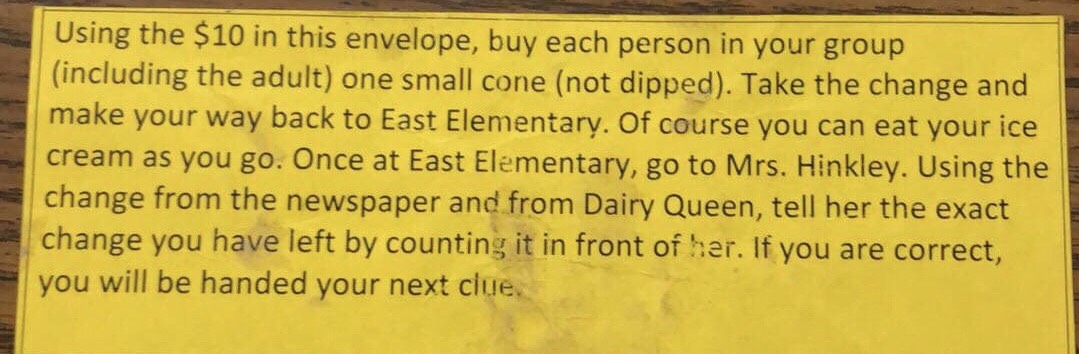
One of the things that I often noticed about my classroom was that the community was very supportive but my class never really got to know the community. Whenever I needed anything, I could always go to a business, explain what I wanted to do, and get some sort of support. One day it came to me that I needed to somehow get those kids to give back, be grateful, and to get to know our local businesses. With that, I came up with The Amazing Math Race. 
This can be done either at the beginning of the year or towards the end. It is best to do this in a community in which you can walk from business to business. What I do is get the students in groups of three and assign the group a parent volunteer. Each group is handed their first clue to the business where they have to go and the race begins. Groups leave every fifteen minutes so there isn’t a traffic jam at each business. I also go over these rules:

· Each team will depart 10-15 minutes apart from each other.

· Each team must complete the math problem correctly in order to get the next clue.

· WALK through the downtown area and inside businesses.

· When you are downtown, make sure you are aware of the construction around you.

· When you are inside a business, you must walk in quietly and whisper. Do not touch any displays that are out unless it is necessary to solve the math problem.

· After you received a clue, you must say thank you to the person who handed you the clue.

· There will be no arguing during the race. Remember, you must work together. If a chaperone needs to talk to you repeatedly, you will go back to East with Mr. Hall.

· At 11:30, go to Washington Park where we will have lunch. If you are working on a clue at that time, come to the park after you have correctly solved the problem and have been handed your next clue. You must not open the next clue until you have finished eating your lunch.

· After all of the clues have been solved and you are back at East, you may do something in the room until Mr. Hall returns. That also means that chaperones may not leave until Mr. Hall is back to East.

· While it is called a race, this is not a competition. The whole point of this is to have fun, work on teamwork, and use the concepts we have learned in class.

· Enjoy the race!

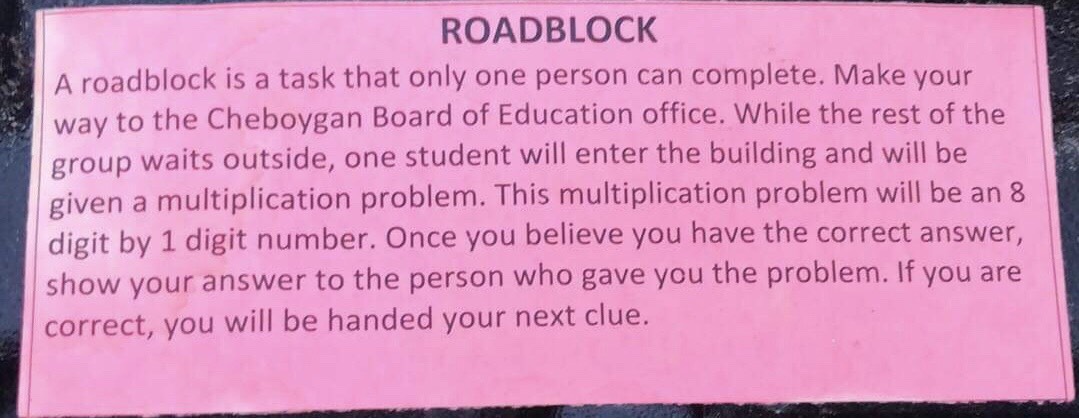
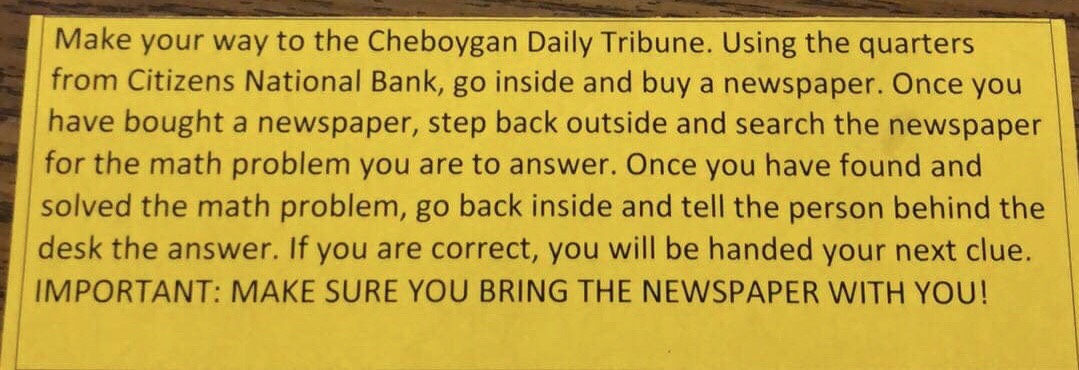
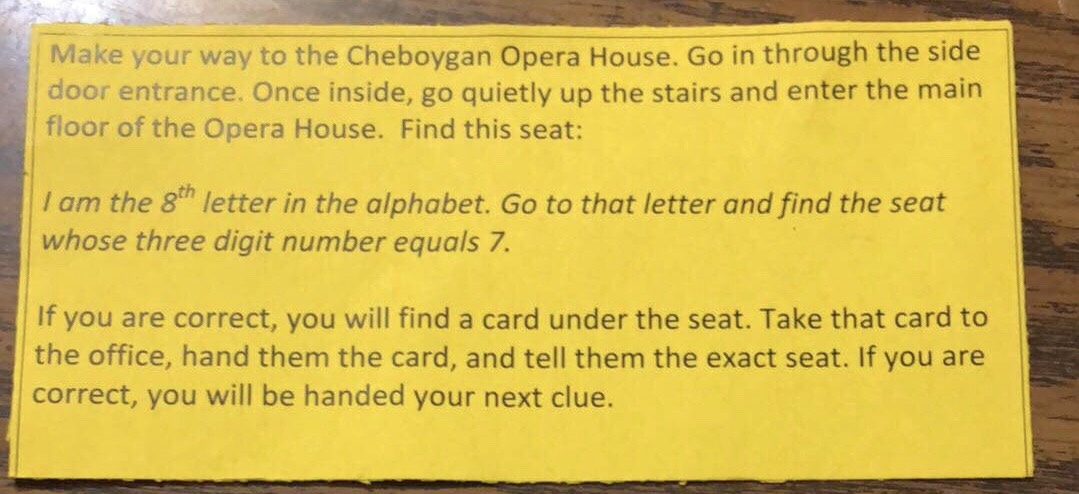
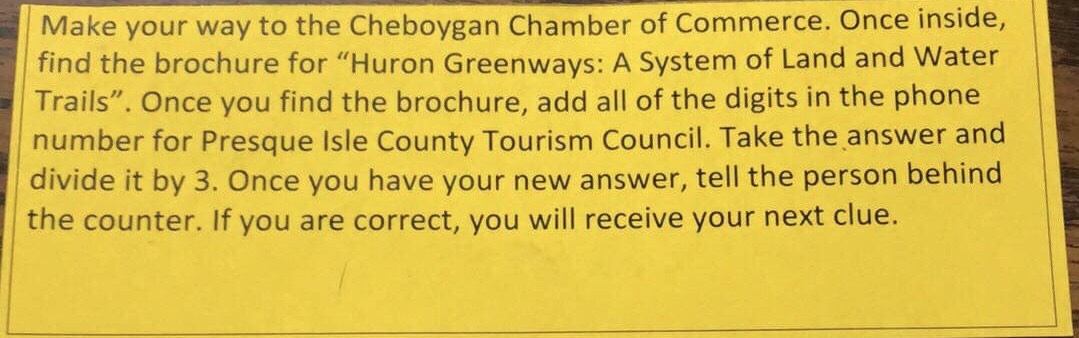
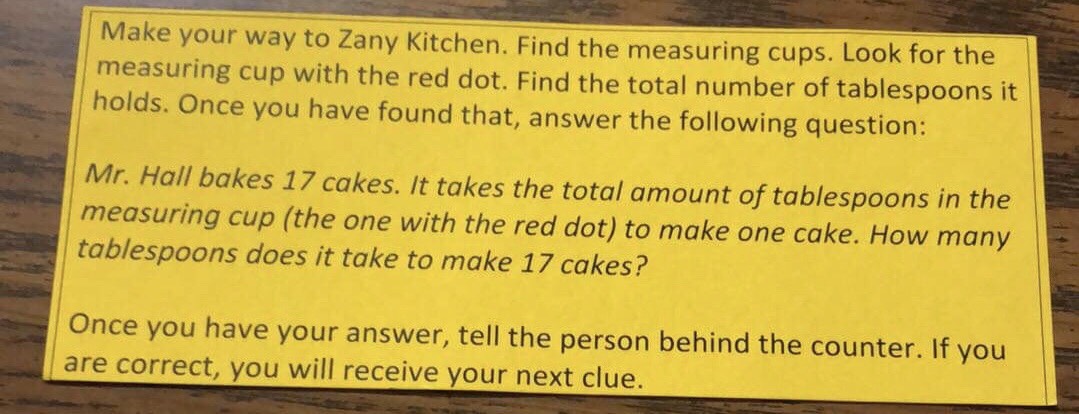
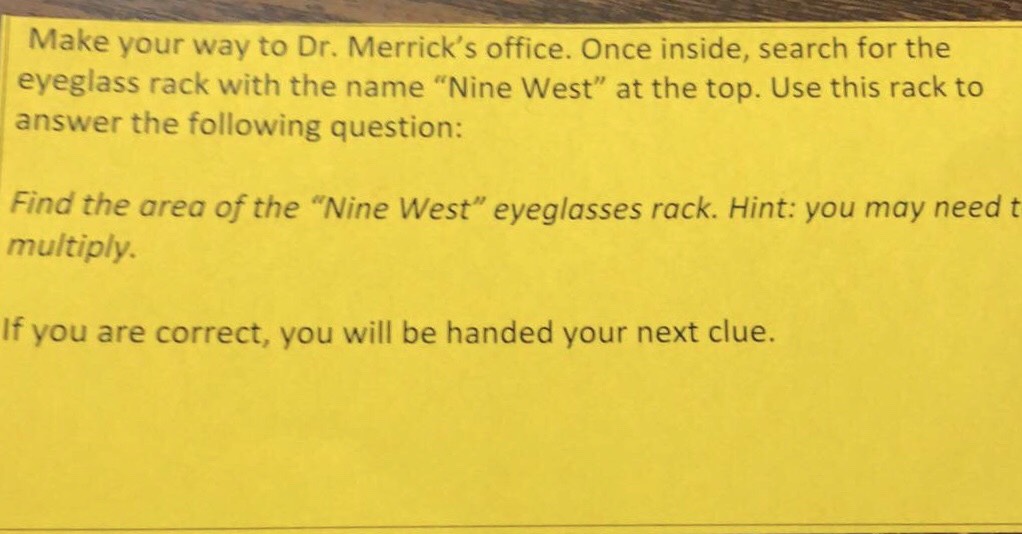
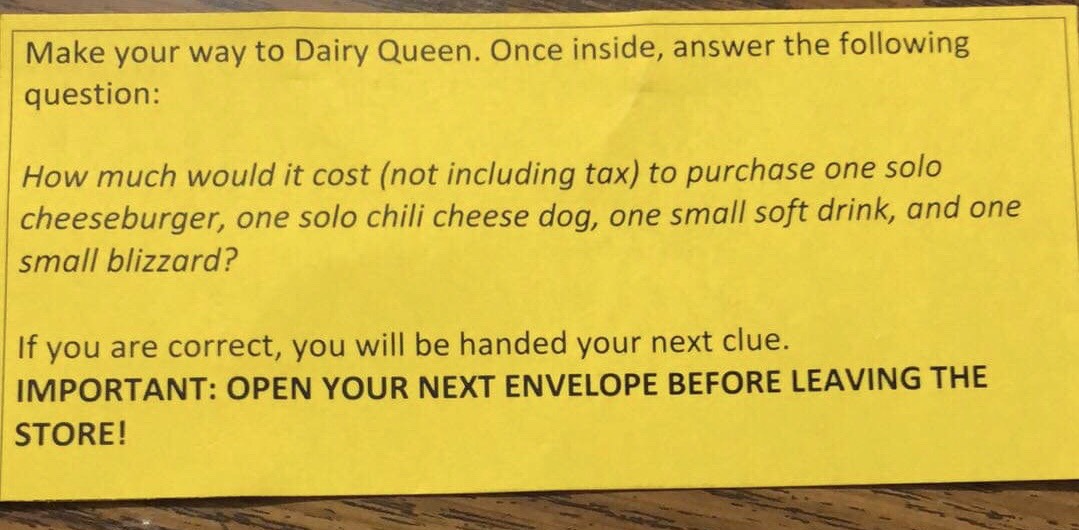
How do I set all of this up? Well, I go from store to store and ask each owner if they would like to participate. If the owner says yes, we work together to come up with a math problem for the students to solve. Once we have the problem written, I type it out, put it in envelopes, and deliver the envelopes (and answer) to the business. When students come in, they attempt to solve the clue, ask the business if their answer is correct, and, if it is, then get the envelope to go to the next business. 
By doing this, students are going into stores, interacting with those people that have helped them (either financially or through donations of supplies), and are going home and telling parents about the cool stores we have downtown.

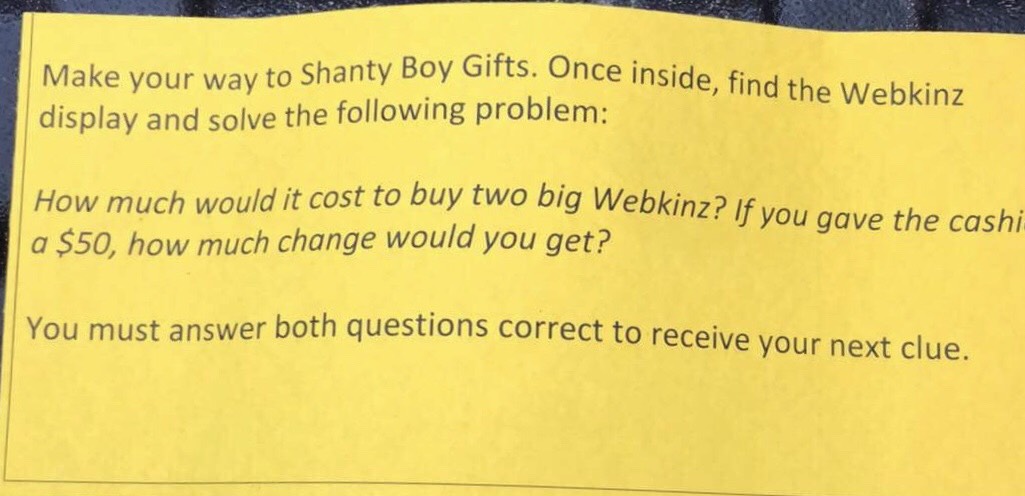
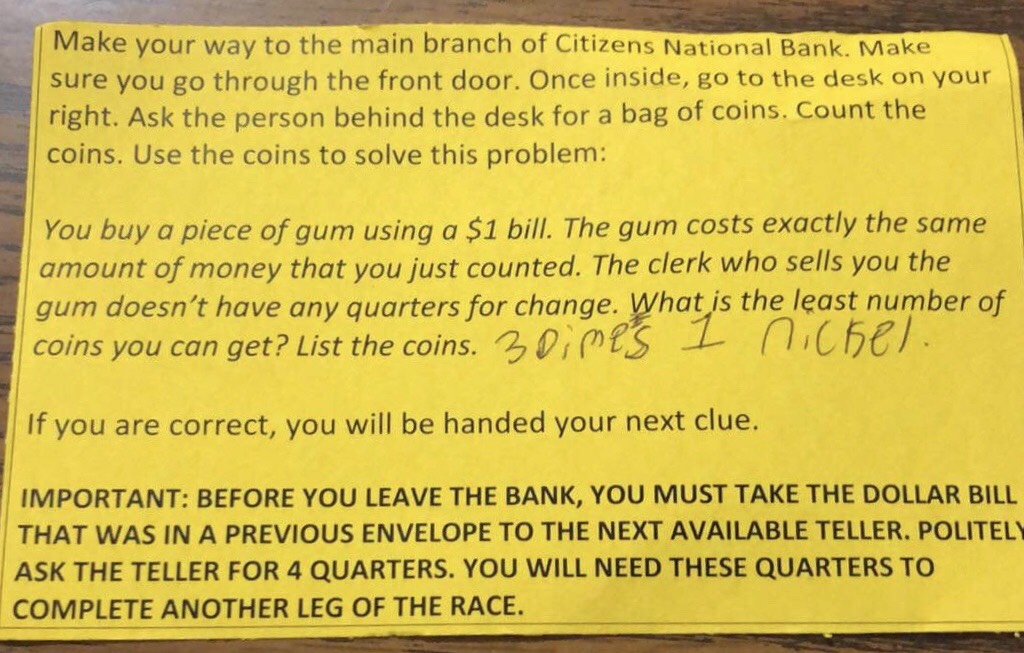
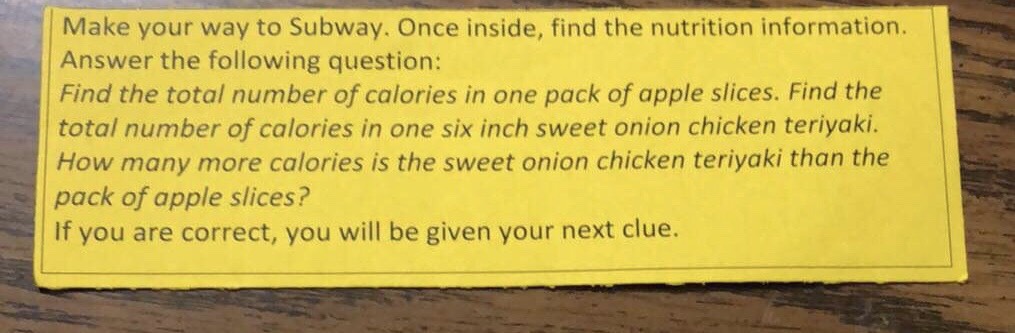
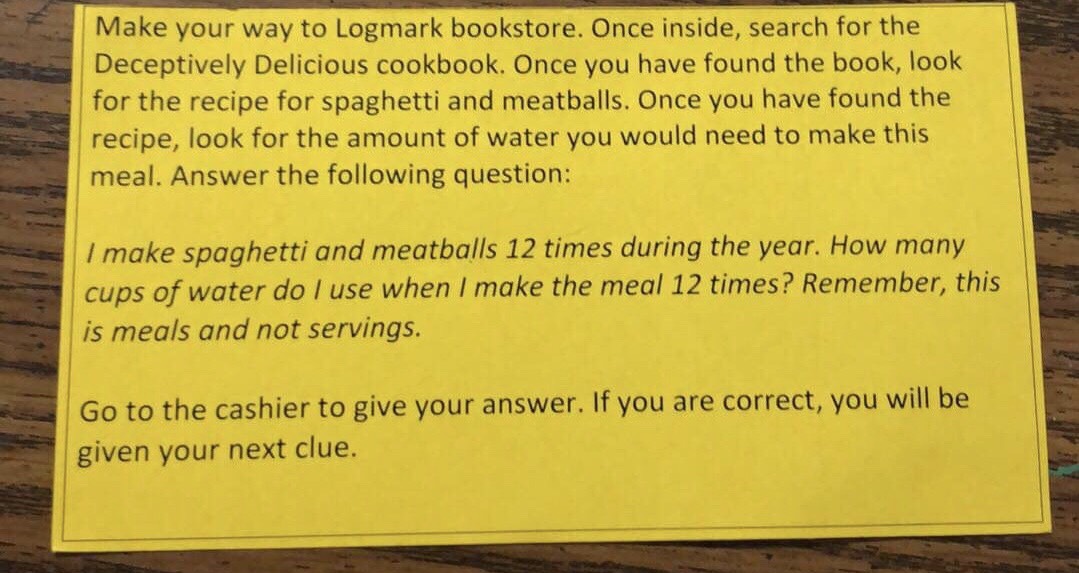
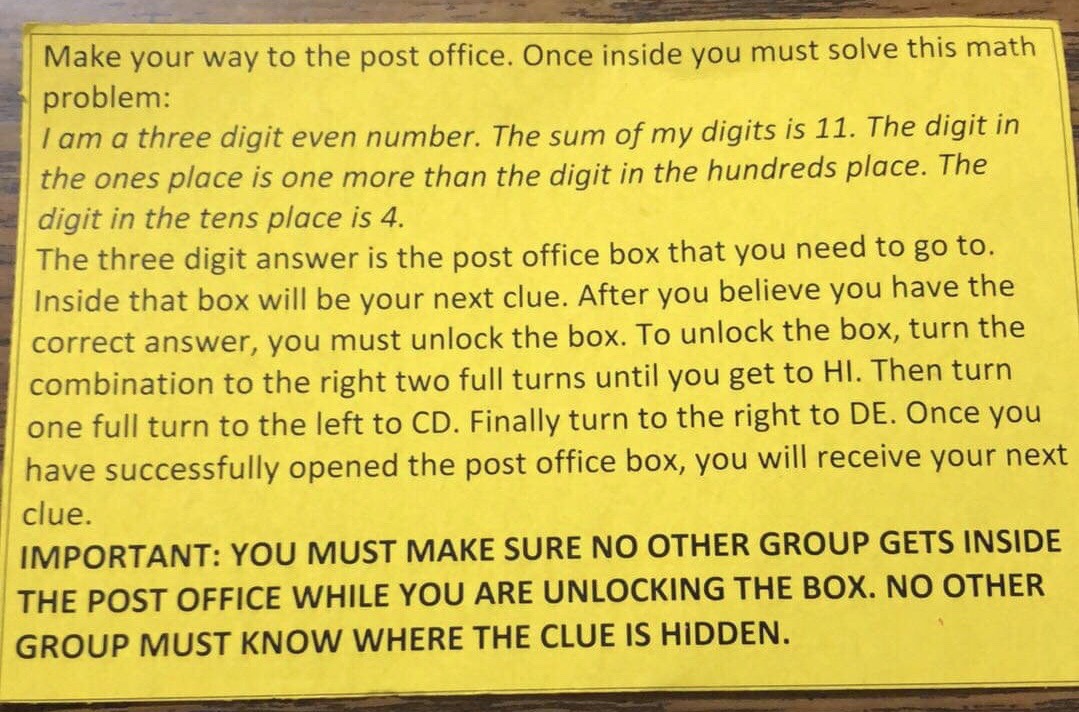
I have attached the clues in the order in which they are handed out. For some reason, I can’t find my 5th grade clues so here are the ones we used when I taught 3rd grade.

I know it is a lot of work but The Amazing Math Race is so worth it! After my first year, I had a local business make Amazing Math Race shirts designed by a student in my class. So now the kids wear The Amazing Math Race shirts when we have the race. We have had clues printed and hidden in the newspaper (even to the point where readers of the newspaper will send us the answers to the hidden clue), stuffed in a post office envelope, and hidden underneath seats at our local Opera House!

Math Detectives

Here is one of my favorite activities. I do this for a math review, but it can be done for any type of review. Not only do the kids like it, it involves other members of the school community. For this activity, I call my classroom “Problem Solving – SMU (Special Math Unit)” The day prior to the kids coming in, I write different word problems and put them in envelopes. I then go around the school and ask staff members if they would be willing to hand an envelope over to my detectives when they ask for it. I tell them that they should be dramatic when they hand over the envelope – showing some kind of concern. The envelopes are handed out to the custodian, cook, secretaries, classroom teachers, librarian. Really, anyone who wants to participate.
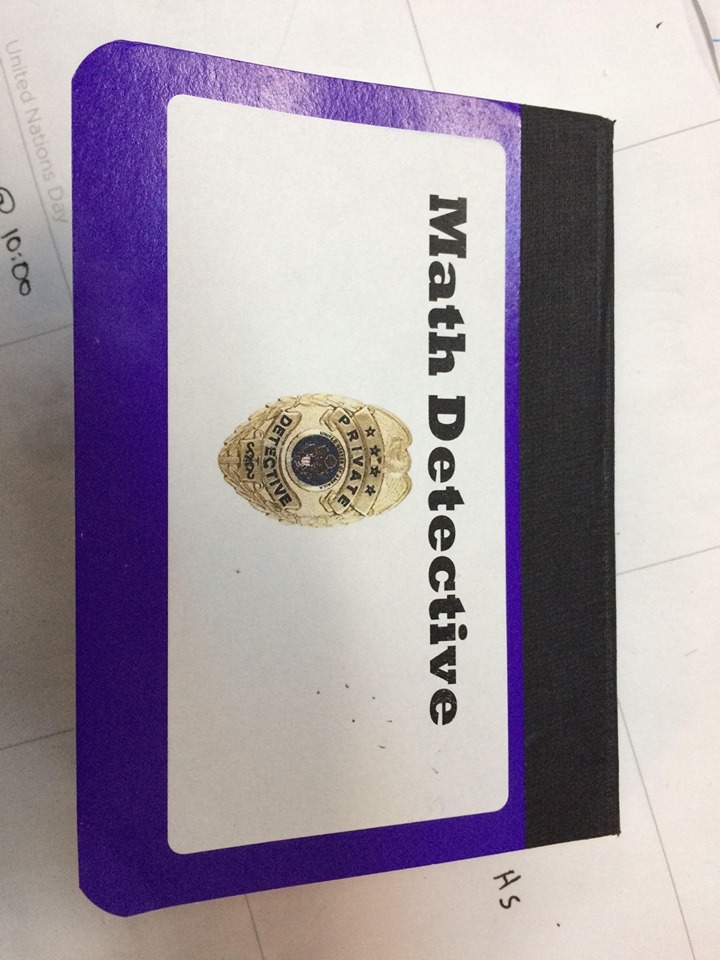
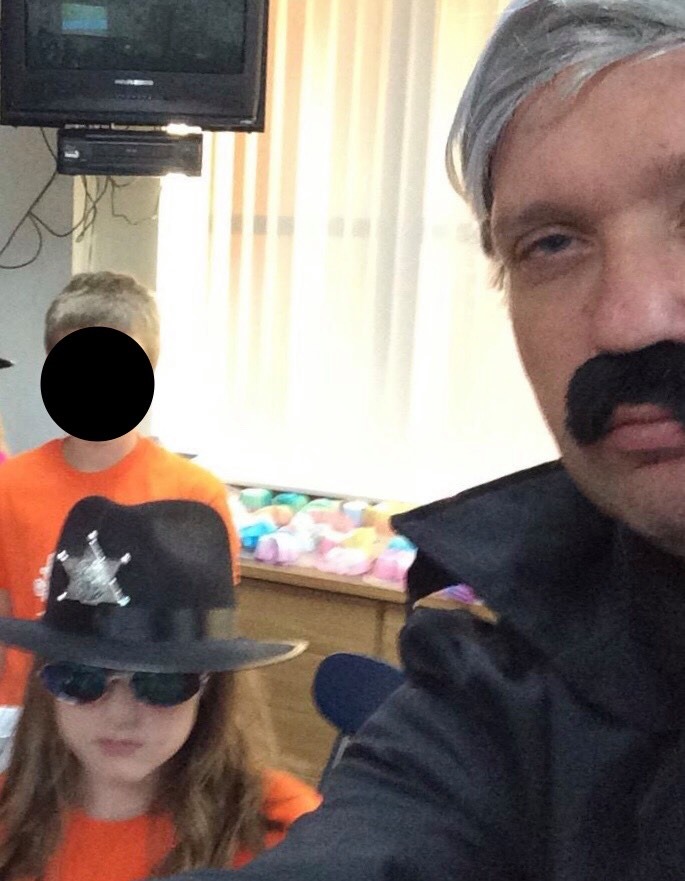
When the students arrive the next day, they walk in to the room and on their desk is their math detective notebook, a detective hat, some old suits and ties, a coffee mug, and a doughnut. The COPS theme song is playing and I am dressed as the old school detective who didn’t play by the rules and is now on desk duty.Once they sit down, I explain (in my worst Brooklyn accent) that various crimes have taken place that we will need to solve. At that moment, my phone will ring (via my cell phone calling my classroom. I pick it up (talking to no one of course) and get all dramatic about how a crime has taken place in, say, the cafeteria and Detectives Smith and Detective Jones (student last names) need to go to the scene of the crime and bring back evidence. So my two detectives head to the cafeteria. The other students get their notebooks ready, eat a little of their doughnut, and sip their “coffee”. When the detectives return with the envelope, we open it up and attempt to solve the word problem. Once the detectives discuss the different ways they solved it, we consider the case closed. Right when that case is solved, the classroom phone rings again and we are back at it.

I love to hear from the school staff about the different interactions they have with the detectives when they go pick up their envelope.

Their Math Notebooks
The ornery sergeant with his team.
Solving the case
Asking the tough questions!
Design a site like this with WordPress.com
Get started