Often, I am asked how kids respond when they come in my classroom and see it transformed into whatever it is we are doing that day. I actually prepare them. A couple of days prior to the room being transformed or an amazing activity that is going to occur, I put up this sign. This gets the kids talking and guessing about what they think is going to happen. It builds up a great deal of excitement! Like the sign says, they never know what to expect! Feel free to print it off and use it!
If you have to teach Henry Ford and The American Industrial Revolution, this is a fun activity. I am sure a lot of you already do this but, if you don’t, here is a good overview. After students read Who Was Henry Ford, I set up my classroom like a factory. We start by having five rows of desks. Each row has four workers and a quality control inspector. Tell the students that, prior to Ford’s assembly line, it took a long time to build a vehicle. Once Ford developed the assembly line, where each employee had a specific job, the process moved faster – causing more cars to be built at a cheaper price. Since the class can’t build cars, our room is set up like the Hershey chocolate factory. Before starting the assembly line, I love showing the students the famous I Love Lucy clip where Lucy and Ethel are working at the chocolate factory. The kids love it. After I show the clip, I stand on my desk and go into this long crazy story about how the Hershey factory closed down due to unforeseen circumstances and they need our help. It is important that we each do our job well so that Hershey Kisses can continue to be sold in stores. Each student eagerly agrees. Before they go to their stations, each student puts on a hairnet, gloves, and an apron. They are then assigned a job. One student cuts out the foil, one student places the Hershey flag on the foil, another student puts down the unwrapped Hershey Kiss, and the last student wraps it. At the end of the line is the quality control inspector. His/her job is to make sure the Kiss is completely covered and meets their expectations. The assembly line stops after one minute. Students count the number of quality approved kisses. They then meet to discuss how they can go quicker but with the same, or better, quality. After doing this three or four times, they have a system that works for them. Once we finish on the assembly line, I then have each student do all the work by him/herself. By doing this, they can see how much longer it takes for one student to do all of the work rather than working as a team. To end the activity, we do something fun. I bring in a treadmill (“borrowed” from the high school workout room) and have each team stand at one side. I then set the treadmill at the lowest setting. This moves the Kiss down the line so the students have to do their job without touching the kiss (just like an actual assembly line). Then we speed up the treadmill to see how fast they can do it. It’s quite funny! I included a couple of pictures. Funny enough – when we were doing to assembly line activity, the local news came in to do a story on the class donating Halloween candy to the soldiers overseas. You can see the big pile of candy on the back table.
I love doing this money math review that I call “Scenes from an Italian Restaurant”. Prior to the kids coming in, I group the desks together, cover the desks with a fancy tablecloth and a small glass candle holder with a battery operated candle. At each seat, there are small dinner plates with a menu sitting on the plate. The menu contains different food items with different prices. When the kids come in, they are greeted by ornery Chef Henry. As the lights are dimmed and cheesy coffee house music plays in the background, they go to their reserved table. After everyone is seated, they start to look through their menus. As they are perusing their menus, Chef Henry passes out an appetizer. This is my favorite part because, not only do I get to use a bad accent, I also get to make up names for the appetizer. For example, cheese puffs might be called “poofs de cheeses” or Oreos might be called “teeny chocolate finger sandwiches”. After the kids have their appetizers, Chef Henry calls on a student to place his/her order, but he tells the student what types of food he/she can order (ex. one appetizer and a drink or a drink, main course, and dessert). While the student is ordering, the rest of the class lists the prices of the items the student ordered. The students then have to add up the prices and get the correct amount. However, they really have to pay attention because Chef Henry may drop an item or tell the student that the item is on the house so the students have to subtract or not include it in the total. After the total cost is determined, students also have to figure out the tax (6%) and a tip for the Chef (who tells them the percent they should give – usually 15-20%). Throughout the dinner, the Chef continues to pass out food with quite ridiculous names (kids favorite – teeny squishy grizzlies (Gummy Bears)). The kids love Chef Henry because he is grouchy and has a ridiculous accent!
A couple of years ago, I went to a training on restorative justice. I had always felt like I had my classroom management under control but felt like students saying, “I’m sorry” didn’t seem to have the impact that I hoped it would. In a nutshell, restorative justice is all about repair. How can a student repair a relationship with another student who has been harmed? It’s not too often that I come away from a professional development with a renewed sense of excitement. This one I did. I felt like I needed to change what I was doing, hold kids responsible, and make sure that kids understood that their words and actions impact those around them.
Most educators are familiar with the Ron Clark Academy. I have never been but have heard great things. One of RCA’s great ideas involves utilizing a house system. I think it is a great idea and one that should be used in all schools. However, I didn’t want to just take their idea and copy it. I wanted to make it my own.
The first thing I did was decide on how many houses I wanted. I had twenty-four kids on my roster. I felt four houses with six kids in each house would be perfect. After settling on the number of houses I needed, I began listing character traits I wanted my students to work on. I narrowed it down to four – loyalty, wisdom, caring, and bravery. Taking those four traits, I used Google Translator to list these words in other languages. Here is what I came up with: Waibu – Chinese for caring Valeroso – Spanish for brave Busara – Swahili for wise Fidele – French for loyal
After naming each house, I assigned each house a color and a mascot. Now it looked like this: Waibu – Chinese for caring. Color: purple Mascot: elephant Valeroso – Spanish for brave. Color: orange Mascot: bear Busarsa – Swahili for wise. Color: green Mascot: Owl Fidele – French for loyal. Color: blue Mascot: Wolf
With everything in place the way I wanted it, I reached out to a friend of mine who was a graphic designer. I asked her if she could turn my ideas into crests. She agreed and sent me these designs:
After receiving my crests, I came up with an idea. What if I kept the kids together in the same houses all year? Each house would sit at the same table and never get to sit among other houses. I told my wife, a Title I teacher, my idea. “You’re crazy!” she said. The idea of kids sitting together and never moving, even if they had conflicts with kids in their own house, was absurd. I decided to do it!
I arranged groups of six desks and put a sign above the desks stating which house it was. I began looking for supplies to match their house color. Every school supply Busara had was green. Everything sitting at Waibu was purple. You get the idea.
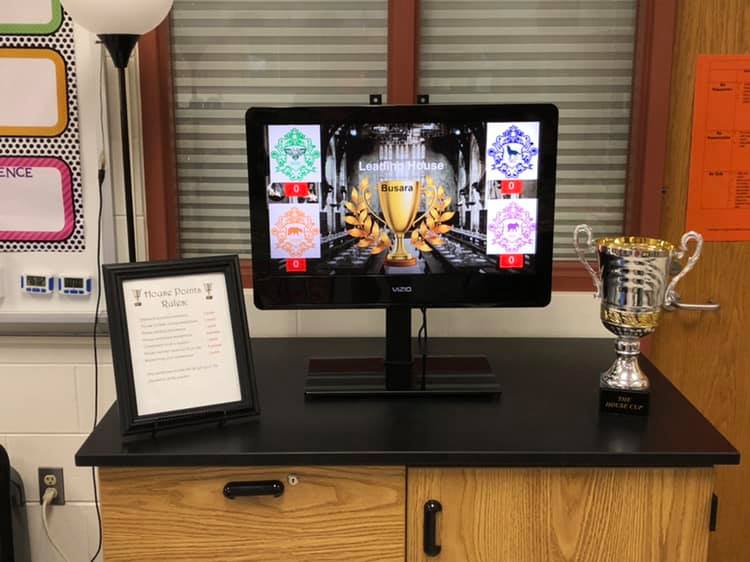
After getting all of that arranged, I went to a local trophy shop and asked them if they could donate a house cup. They gave me this beautiful cup that sat on a heavy marble block. They even engraved it so it read House Cup.
Now that I had houses arranged and a house cup for the winning house, I needed a way to track points. I created a PowerPoint that I would keep playing throughout the day. As students earned points, I kept tallies on the board. I would then update the PowerPoint a couple of times a day to show each house where they stood with points. I also made a document telling the students all of the different ways they could earn their points.
Prior to the first day of school, I do home visits. I love sitting down with families and going over all of my expectations for the year. When I meet with the kids and families, I also tell them what house they are in. I don’t sort on the first day of school because it is important for me to have a mix of strengths and weaknesses in each house. That way students can rely on each other’s strengths to solve different problems I throw their way.
The first day of school arrives and kids sit at their houses. The first decision they have to make is what I call a Decision Making Model. This is the process that each house will use for solving conflict. I told them that this model can change if they see that it isn’t working. After about thirty minutes of discussion, each house had their model. I just kept my fingers crossed that they would stick with it!
Throughout the first month of school, we did a lot of team building within the houses. Students had to work together and rely on each other to solve different problems. Really, what I had to do was get them to trust each other.
Every morning, we had circle. Circle was a chance for students to either learn a social skill I felt they needed, talk about something that was bothering them, or conflict resolution. It was during one of these circles that a student suggested that each house needed something more. I said, “You have a house color, crest, and mascot. What else would you like?” The students replied, “I think a house chant would be cool! Something we could do at the beginning of each day.” I never thought of that! I love when kids come up with amazing ideas!
Luckily, I had a former student that became a professional poet. I reached out to him and asked him if he could write some house chants. He loved the idea of unity and what I was trying to do. He wrote each house a chant. The students either agreed with the chant or would ask for a revision. By the end of the week, each house had a chant. Every morning, after saying our daily affirmations, each house would stand up and say their chant. Most of the houses even added dance moves to go with them. Here are the chants:
During another circle conversation, students asked if we could get a stuffed animal to represent each house. Another great idea! After a week, the house mascots showed up. Each house got to name their mascots (using the Decision Making Model to agree). They treated the mascots with such reverence. Each house dressed their mascot up and took turns holding them. It was so amazing to watch. Those stuffed animals became part of their house. During another circle conversation, students asked if we could have house shirts made with their crest and color. Yet another amazing idea! I went to the local design shop and asked if it could be done. The owner thought it was an amazing idea and gave me a great deal on the 24 shirts that I purchased. In fact, he gave me his card and told me that he could make other items bearing the crest. I passed the information along and soon students started coming to school in their house hoodies, hats, and sweatshirts. I saw parents proudly wearing their child’s house crest on a t-shirt. Parents even had house crest bumper stickers to show their house pride. It was so cool!
In December, I decided to surprise the kids by having a professional photographer come in and take pictures of each house. What they didn’t know is that the photographer was going to place them in a scene depicting what their house meant. For example, the Busara house would showcase the students reading while the Valeroso house would show their bravery when standing by bears (their house mascot). The kids were really excited when I handed them their pictures. This is what they received:
Each marking period, the house that had the most points earned the House Cup. This was a big deal! Not only could they keep the cup at their desks, they also got to go on an amazing adventure. One time it was taking a limo to Pizza Hut, another time was getting a personal tour of the local TV studio. Each time was something different and something special. I thought for sure that the houses that didn’t win would be upset with the winning house. Boy was I wrong! In fact, I would see different houses passing notes to other houses. Here are just a few examples:
Was there conflict? Absolutely! How did they solve it? Each house devised their own way of managing conflict. All of the houses did choose to work out their issues in a circle. They had each created an object as their talking stick and would pass it around when they wanted to speak. Kids knew that the decisions that were made in their personal house circle was the decision they would stick with (even if they all didn’t agree).
One time, I decided to mix kids up to see if they could form new houses. That was a big mistake and several students creatively protested throughout the week. One time I had the students take out their white boards to write down a math problem. When I turned around, they had their original house names written on their boards! Some students wore their original house shirts all week! Finally, after a week, the experiment ended and they all went back to their houses. There were hugs and explosions of laughter. It was like they hadn’t seen each other all week!
At the end of the year, kids struggled to say goodbye. They had grown close to their housemates and didn’t want to leave. The following year, I would see my former students still wearing their house shirts, sneaking in to my room to give their mascot a quick hug, or proudly saying their house chant with a current member of the house. I know, more than anything I had done before, making these houses changed them and me!
This picture was put on my desk the year after the kids in this story moved on to the next grade. It shows how tight of a class we became.
I believe the two biggest challenges that teachers face are classroom management and motivating unmotivated readers. I think classroom management is perfected over time. My philosophy on classroom management is – to each his own. There are things that I would allow my students to do that other teachers might not. I am firm believer that the kids should have fun while learning. We laugh A LOT but we also know when to be serious. Our classroom motto is Carpe Diem (seize the day). We try to follow that motto in our own lives and in the classroom.
Getting an unmotivated reader to read is a little more tricky. I have seen several teachers use reading surveys to gauge interest levels. I have seen teachers do book tasting parties. Those are wonderful ideas! Quite a few years ago, I came up with something that works for me. It’s called the Hallberry Awards (I use my last name quite a bit for different activities!). Here is how it works.
At the beginning of the year, I have a bulletin board that is titled “The Hallberry Awards”. On the board, I nominate picture books for different awards. I start off with picture books because they are quick reads. Also, isn’t it amazing how an author can grab an audience and teach a lesson in only thirty-two pages?
To give you a better idea of how this board looks, I may have a category called “Funniest Picture Book”. Under that category, I have printed off the covers of the books that are nominated (ex. The Book with no Pictures, This Book Just Ate My Dog). I usually have four books for each category. I typically put four categories on the board. (ex. Best Lesson on Empathy, Best Illustrations, Best Book about Respecting Others). Then I go to the library and try to grab as many copies of the nominated books as I can. In front of the bulletin board, I keep copies of the books as well as ballot boxes for each category. Students have one month to read all of the books that are nominated. By having the kids read all of the books, they are deciding, on their own, the types of books they like. In addition, they are being exposed to different authors. Throughout this month, students can vote for their favorite books.
At the end of the month, we have The Hallberry Awards. The night prior, I tally all of the votes in the boxes to determine the winner of each category. I I then type out the winner and put the results in fancy envelopes with the categories written on the outside of the envelope. I also turn my classroom into an extravagant ball room. We have a chandelier hanging from the ceiling and desks arranged with white tablecloths covering the desks and fancy dishes sitting on top. Each set of desks has a battery operated candle sitting in a glass in the middle. We have a podium in the front with a fake microphone sitting on a stand. Seriously, we put the Oscars to shame. When students know that The Hallberry Awards are going to be the next day, they come to school wearing their fanciest clothes. We want to look good when we find out the winner.
Prior to The Hallberry Awards being announced, students sit at their desk and have a pastry. It’s like our pre-awards meal. While students are eating, two students are selected to announce the winner of the first category. The first time I do this, I write out what they say. After the first month, the presenters come up with their own dialogue. Here is what the dialogue would look like – Samantha and Bill walk up to the podium. The audience claps. The two start to banter: Samantha: Hey Bill, what do you get when you cross a lunch box with a book? Bill: I don’t know, Samantha. What do you get when you cross a lunch box with a book? Samantha: You get food for thought! Bill: That’s funny. Want to know what else is funny? The books that are nominated for Funniest Picture Book!
Seriously, that is how it goes. It is so ridiculous but the kids love it. After the two presenters name the nominees, the class does a drum roll as one of the presenters opens the envelope and reads the winner. The class cheers as the winner is announced! After that category is finished, two more presenters come up and the award show continues.
At the end of the show, the winners in each category get a sticker attached to the front of the book announcing the category they won. For example, all copies of our book, The Book With no Pictures, has a sticker that says “Funniest Book 2018-2019”. By doing this, future classes can see which books have won and may spark their interest to pick them up and read them.
After a couple of months of using picture book, students start nominating chapter books for The Hallberry Awards. Because they are chapter books, we give students two months to read all of the books that are nominated. Again, by having the student read all of the books, they are being exposed to different genres and, ultimately, finding either an author or series that they enjoy.
The biggest event of the year is the award for Best Book of the Year. This is a highly coveted award. Students are serious about this one and even campaign to get their favorite book selected. Just like all of the other Hallberry Awards celebrations, we go through our different categories. Students are excited to hear the winners of those categories but can’t wait to find out which book won the Book of the Year. Because it is such a high honor, we invite someone special to come in and announce the winner. In the past, we have had the principal, the mayor, the superintendent, and even a local radio host. This is a big deal. The winner of the Book of the Year gets their cover framed and hung on our “Hallberry Book of the Year” bulletin board. In addition, the students write to the author to tell him/her that he/she won. We even send the author a certificate.
In years past, the local library has even promoted the book that won. I always like to tie the community into what we are doing in our classroom.
This is a fun activity and one that will get even your most unmotivated readers to start reading! Drop a comment below if you have any questions.
I belong to a Facebook group where over twenty-five thousand amazing teachers share wonderful activities, stories, and ideas. In fact, this blog is the result of some of those teachers asking me if I had a place where I kept all of my ideas. Recently, I posted about how I start a parent-teacher conference and teachers asked for more information.
Before I tell you all about it, I want to give you some background. I have been fascinated with parental involvement since I was taking college education classes. In fact, my Master’s thesis was on improving the parent-teacher relationship. I firmly believe that, if you can connect with parents, you are going to have a great school year. There are many ways in which I work to better that relationship. One of them is through the parent-teacher conference.
When my district holds conferences, they tend to limit them to ten minutes. That is not nearly enough time to discuss progress as well as address parent concerns. I am fortunate to have enough time throughout the year where I can keep in constant contact with parents via Remind. I also have a closed Facebook group where the class has live video updates and pictures. In that group, I share the daily circle conversation so it can be further discussed at home.
One of the most powerful things that I do during the conference is not actually done by me. It is done during those circle conversations. Let me explain. A couple of weeks prior to conference time, I sit down with the kids and I talk about how every student is important to the success of the class. If one of us is absent, all of us are affected. In order for the class to work as a whole, everyone needs to be present because we all have gifts to offer that make us even better. We then spend some time talking about positive qualities that each of us have. After our conversation ends, I ask each student to pull another student’s name out of a bucket. They are not allowed to say whose name they picked. They have to keep it private. Once all names are drawn, students go back to their seats and write a quick letter to that student’s parents telling them something positive about their child. It is a quick three to four sentence free write.
After all of the students have written something, I collect them. The first thing that jumps out at me is how amazing kids are at finding important, but sometimes overlooked, qualities in each student. Reading those quick writes is one of the highlights of my year.
A few days before conference time, I have volunteer come in and take the letters. That volunteer then starts calling each student to another room to record that student addressing the parents. It is a chance for one of my students to tell a fellow classmate’s parents about their amazing child. Some times the kids go off script and go even deeper and talk longer.
On the night of the conference, I have a laptop set up at the conference table. When parents come in, they sit down and I tell them I have a quick video I want to share with them. I press play and watch as parents see another student talk about their child. Imagine that. These videos give parents a chance to see how their own child is seen by his/her peers. Most of the time, the parents end up crying. A lot of times, I hear parents say, “I never know my child was seen this way.” or “It is so nice to hear the good things.” Typically, when the conference ends, parents go home and share what their classmates said about them. In doing so, I see a change in that student’s behavior as well. The student sees that others see potential and hope and positivity. Their own mindset starts to change. It is a joy to see!
This is my twentieth year teaching in the same district. Over the course of those twenty years, I have taught 2nd, 3rd, 4th, 5th, Title I, and a K-5 STEAM class. These moves have given me the opportunity to try new things and learn more about the different age levels.
During my fourth year of teaching, I was assigned to third grade. Most of my career, at that point, had been teaching fifth so it was some adjustment. Throughout the year, I learned to love 3rd graders. Third graders are just so innocent and enjoy the magic of school. This particular third grade class was just that – magical.
In September, the class was reading a TFK (Time for Kids for all you non-teachers) article about kindness. The article centered around being kind to others. This started an interesting discussion on how we, as a class, could be kind to others. I said, “That is a great idea! What could we do to be kind to others?” Now, if you ever have taught third grade before, you know that their imaginations can run wild! After several minutes of nearly impossible things, I decided we needed to narrow our focus. “How about this – let’s name some people we would like to do an act of kindness for?” Students started shouting out different people in our community. We finally narrowed it down to a handful. They were: the custodian, a veteran who lived down the street from the school, a volunteer grandma, the school cooks, our school secretary, and our PE teacher. “Those are some great names.” I said. “How would these people know that we did something kind for them?” a little girl spoke up. “Well,” I said, “maybe they shouldn’t know. It could be a random act of kindness.” The class agreed that that was the way to go. Although they felt a card should be handed to the person so they weren’t confused that an act of kindness had taken place.
The first person we decided to target was the volunteer grandma. I told the kids that I didn’t want to be involved in the planning of these acts of kindness so it was up to them to come up with the idea and put it in play. The kids all talked and decided it was best that they gather some intel first to find out more about her. When she came in to class, they started peppering her with questions (not too subtly either). Where do you live? What do you like to eat? How do you get to school? Seriously, it was like an interrogation! After the grandma left, the students decided what they wanted to do. They decided to hire a limo to pick the grandma up and take her to school. Yes, you read that right. I told the students that was going to be expensive and we don’t have any money. One of my third graders, Glen, piped up and said, “I’ll handle the negotiations.” I swear that is what he said! I found a local travel agency that also had limos. Glen called the agency, asked to speak to the manager, and started telling her our plan. I can only imagine what she thought as a seven year old was trying to convince her to pick up an elderly lady in an apartment complex. After about fifteen minutes of back and forth, Glen hung up. “We are all set.” he said. Apparently, he convinced the owner that this was all on the up and up. I am still not sure how. After more interrogating, the kids were able to find out what time she left for work. That gave Glen the chance to call the agency back and set a date and time. In the meantime, the students designed a card that the limo driver was to give the grandma when he knocked on her door. Other students made a big sign that we planned to hold up when she was dropped off. A couple of days later, a limo arrived at the grandma’s door. She was shocked and confused when he handed her the card and said, “I’m here to take you to school.” When the limo pulled up, she saw eighteen third graders jumping up and down and holding their big sign. Hugs engulfed her as she got out of the vehicle. Later, she told me she felt like a rock star. When everything settled down and our day went back to normal, the kids decided they wanted to do it again. And boy did they ever!
One month, they made a full course meal for the night custodian when they found out he never had time for dinner. Another act of kindness involved having a flag flown over the US Capitol building in Washington, D.C. and then presenting it to the veteran down the street. When the school secretary was overheard complaining about her office chair, the students got on the phone to Office Max and made a deal. The cooks weren’t given aprons – we decided we would make them some. What was amazing was that the kids did all the work themselves. Kids went to Wal-Mart to buy the groceries for the custodian. Other kids contacted their Senator about the US flag. Each student became a project manager of sorts and assigned jobs to different people. Kids arranged bake sales to fundraise for these projects (when Glen couldn’t get us something for free). It really was amazing to watch. What we didn’t know is that we were about to be nationally recognized for what we were doing.
In May, it was time to do something kind for the PE teacher. As the students became better about getting intel without being so obvious, they found out that the PE teacher, Ms. Golden, liked the Ellen Degeneres Show. This was Ellen’s first year hosting her show so it was new to most people. The two project managers for this act of kindness, Trent and Ali, decided they would write a letter to Ellen in hopes of getting a shout-out to Ms. Golden. They wrote the letter and sent it through the school mail. I had proofed it to make sure it looked good. What I didn’t know is that they added a couple of PS’ to the bottom of the letter: PS – There’s two bucks in it for you. PSS – We would hate to have to ask Oprah.
Three weeks after the letter was mailed, I received a call on my classroom phone. It was from a parent who told me she was watching the Ellen Degeneres Show and Ellen just talked about my class. I quickly hung up the phone and told the class. They were so excited. Because Ms. Golden was teaching in a different building (she went back and forth between two buildings), we called her and told her she had to watch Ellen THAT NIGHT. She agreed. When I got home from work, I anxiously awaited for the show to come on. When it did, I was stunned that not only did Ellen read the kids’ letter, she also gave Ms. Golden a special shout-out. In addition, she started a random acts of kindness award called The Holla Award and wanted people who watched her show to write to her about an act of kindness they had done! Amazing! The funny part was at the end of the segment when she told the kids that she wanted her two dollars.
When we got to school the next day, the kids were all excited. Trent and Ali spoke up and said they wanted to write her back. I asked why and they said they needed to mail her the two dollars. (Side Note: Ms. Golden came in and added two dollars to our kindness fund to pay for future acts of kindness). I agreed and they did.
A week went by and a producer of the show called me at school. He said that Ellen had received the two dollars and wanted to call and talk to Trent and Ali. The problem was she filmed after school so I would have to get both kids together without telling them why. I told the producer that I would have to let the parents know because I couldn’t just give out phone numbers. He agreed but wanted it kept under wraps. However, in order to get the kids together, the parents and I agreed to tell them why. Ali and her parents traveled to Trent’s house and waited for the call. Indeed the call did come. Trent answered, talked for a while, and then handed the phone to Ali. When Ali hung up, neither one of them would tell us what they talked about. “Just wait,” they told us.
The next day, the episode aired during school hours. The class turned on the TV to hear their friends talking on national television. It was amazing to see. What was more amazing is what Ellen said at the end of her conversation with Ali – “How would you and Trent like to come be on my show?”
The room became silent. My jaw dropped. Did they just get invited on the show? Within ten minutes, my classroom phone rang. It was Ali’s mom. She said the producer called and wanted Ali and Trent to be on her season finale. I couldn’t believe it. She was flying two of my students to California to be on her show! News spread quickly in my small town. Soon after, my superintendent called me and told me to book a flight and a room as he was paying for Ms. Golden and me to join the kids and their parents. How exciting!
Two week later, Trent, Ali, both their parents, Ms. Golden, and I were on a plane bound for California. When we arrived, we were treated like celebrities. A limo picked us up (I am sure Glen had nothing to do with it) and took us to our hotel. The following day, another limo picked us up and took us to the TV studio. We sat in the green room as the kids chowed down on all sorts of candy (making sure to save enough for the rest of the class). Soon it was time for Ms. Golden and I to take our seats.
As Ms. Golden and I sat in the audience, Trent and Ali sat on the stage with Ellen and talked the random acts of kindnesses we had done and how it all started. What was amazing was the fact that they reminded Ellen that they were just representing their class. It really was a class effort. Before the end of the segment, she gave Trent and Ali skateboards, megaphones with the word HOLLA on it, and an amazing collection of things that the kids would enjoy. In addition, she invited them to spend the following day at Universal Studios.
When the kids returned to our small town, they shared their stories and gave them some behind the scenes secrets about how the show is filmed. The kids decided that this was the best way to end our year of doing kindness for others. Because, in the end, it came back to us in amazing ways!
The card that we gave our recipients. Glen negotiating with the travel agency.Our volunteer grandma getting out of the limo.The local veteran receiving his flag.The three course meal we prepared for the custodian.Our school cooks wearing their new aprons.Ali and Trent dancing with Ellen after the segment ended.
Early, I posted about a class trip to Philadelphia. I can’t wait to share that story. However, this story is about what didn’t go well. When the students went to Philly, I had prepared them for everything I could. The students had to know what is inscribed on the Liberty Bell, how many steps there are at the Philadelphia Museum of Art, and even how to make a Philly cheese steak. When I take kids on field trips, I want them to already know everything so they can enjoy seeing what they have learned. The week prior, I told the students that they had to bring two envelopes with them – one containing money for food and one for souvenirs.
When we arrived in Philadelphia, one of our first stops was to the Liberty Bell. After exploring the beauty of the bell, students started heading back on the bus. One student, Ricky, was so excited to show me what he had purchased. He reached into his gift bag and proudly showed me an ashtray. Yes, you read that right – an ashtray. I said, “Ricky, no one in your family smokes.” He replied, “I know, but it has a cool picture of the Liberty Bell on it.” Ricky had blown all of his souvenir money and it was only day one. He did not understand the concept or value of money. When I got home from the trip, I told my wife that I had failed to teach these kids what they truly needed to learn – economics. So I spent my summer devising an economic plan that would teach the kids all they should know about money.
My first stop was to the local bank. I talked to a bank officer and explained what I wanted to do. She called the bank manager who proudly offered me deposit and withdraw slips, bank pens, old checkbooks, and checkbook covers.
When I got home, I started playing around on the computer and came up with a money template. I had purchased six different colors of cardstock (each color representing a denomination). At the time, I had my room set up in a theme. That year, the theme was Hallywood (a joke on my last name). So, instead of a president’s face on the front, I used Hollywood studios. Once I had the money printed, I started coming up with my plan.
I went to my classroom and looked around. I realized I could transform my room into different housing units so students could see the difference in how much a rental costs based on square footage and location. I put my desks in five rows. The front row was called Bel-Air and cost a $1,000 a month to sit there. I figured the closest to the front of the room had the best view of the board so, obviously, it would cost more to sit there. The row closest to the windows was called Beverly Hills and cost $750 a month. With a view by the window, it was a steal. The row closest to the door was called Hollywood and cost $700 a month. What a great price for being closest to the door! Then, you have Santa Monica at $675 a month. The Santa Monica kids sat closest to the heater so they have the luxury of being nice and warm during our cold, winter months. Finally, the back row was affectionately called Skid Row. They paid $550 a month but didn’t have any luxuries.
Once signs were hung with prices attached, I came up with a list of jobs (with job descriptions) the students could apply for. I wanted to make sure that the amount of money they earned would be less than the cost of the rent. Here is what I came up with:
Janitor: A janitor is given a specific
area of the room to keep spotless. They must sweep the room after lunch and
before the bell rings. They must also dust the classroom once a week. Pay: $550
a month
Bank Teller: a bank teller keeps
records for four to six students in the class. This student must be good at
math and a person who is honest. The banker takes deposits and checks from the
bank customers and coordinates accounts with other bankers. Pay: $600
Messenger: A messenger must
handle all errands to other classes or the office. They must be able to deliver
oral messages accurately and must know the school staff. Pay: $525
Gardener: The gardener must take
care of the classroom plants. Pay: $500
Librarian: The librarian is in
charge of the classroom library. Students go to the librarian to return or
check out books. Pay: $525
Computer Technician: The computer
technician must turn on the computers every morning and turn them off every
evening. They must make sure students are logged off the computer and keep the
monitors and towers dust free. Pay: $500
Lunch Advisor: The lunch advisor
must complete the daily lunch count and accurately collect and record lunch
money. They must also be responsible for giving the filled out lunch envelope
to the messenger. Pay: $575
Police officer: A police officer
has several duties. Each one patrols a selected area of the room. The officer
has a book with students’ names of all the students in his/her jurisdiction. If
a student breaks any of the class rules, the officer keeps a record of the
infraction. The officer helps collect all of the fines that students pay for
breaking rules. Pay: $500
Attendance Monitor: The
attendance monitor must take the attendance daily. He/she must also collect any
late slips and keep them organized. Pay: $475
Recycler: The recyclers sort the
recycling and bound the recycling when it full. Pay: $500
Clerk: Clerks pass out and
collect papers and keep Wal-Mart organized. Pay: $550
Judge: The judge must settle
possible disputes between a police officer and student. If a student feels that
they did not commit the infraction, they may plead their case before the judge.
Pay: $475
Office Assistant: The office
assistant must check to make sure who did not turn in their homework and record
it on a graph. Pay: $550
Economist: Economists watch which items in the class store are selling and which items no one is buying. He/she uses market research to determine supply and demand and determines prices based on popularity. The Economist gives a weekly report to the class as to why he/she fluctuated certain prices. Pay: $400
So, by making these jobs, I had a whole community of workers who had to earn money to rent their desks. I also wanted some incentives for students to be tempted to spend their money so we had a class store. I figured that if students were never tempted to impulse buy (thanks Ricky) then they would easily earn the money they needed for rent.
After I created the jobs, I printed off ledger sheets for each student. I wanted to make sure that students could keep track of how much money they had in the bank. Once I hired bankers, I would assign four students to each banker. When a student had cash he/she wanted to deposit, the student would go to the bank, fill out a deposit slip, and take it to his/her banker. The banker kept ledgers on each student he/she was responsible for. The banker would then deposit the money (by writing it in their own ledger that they kept on the student) and bring me the money. If a student needed to withdraw money from the bank, the same thing would happen. I wanted to make sure that my bankers were great math students who could also handle the stress of making sure that all ledgers were accurate. It was also important that the bankers knew that they could be audited at any time. A parent volunteer would walk in my room, ask to see the banker’s ledger as well as the banker’s clients ledger, and compare the two. An audit put a great deal of stress on the bankers so they were extra careful in making sure their ledgers were perfect.
During the first week of school, I explained the economic system to the students. I told them that, if they didn’t pay their rent, they would lose their desk and be evicted. I stressed the importance of making sure they had enough money in their accounts when it was time to pay rent. After answering some questions, all of the students understood what to expect. They filled out job applications with the jobs they were hoping to get and waited for me to assign them their new jobs.
A few days later, I gave each of them their job. I then gave them a budget sheet that they needed to fill out that helped them determine how much money they needed to earn and how much money they could safely spend in order to pay rent.
The first month went great. However, we hit a snag. The police officers became power hungry. Students were given fines for the most ridiculous things. We sat down as a class and brainstormed what we could do. The class decided we needed a judge – someone who would be fair and honest. I asked the class to write down the name of the student who should be our judge. Overwhelmingly, the class chose Bea. Once Bea was selected, the class wrote her job description. This is what it said: If a student is fined by a police officer, the student can take his/her case to the judge. Both the student and the officer will tell their side of the story to the judge. After which, the judge can either: reduce the fine, dismiss the case, or keep the fine the same. Regardless of the decision, the student and the officer must shake hands as the matter is officially settled.
I love that they decided this on their own! Once we had a judge, the fines became more meaningful and students typically agreed with the fine. Also, throughout this month, I wanted to test the kids on money management. Every once in a while, I would hold up a candy bar and ask if anyone wanted it. Wallets flew out of their desks and kids started bidding wars over the candy bar. Sometimes, the bids would go as high as $200. I knew that, when rent was due, kids would be losing their desks.
So, payday comes around and I give every student their pay check. Each student signs the back of the check, fills out a deposit ticket, and then deposits their check in the bank. After all checks were deposited, students then took out their checkbooks and wrote me a check for their desk rent. the problem was twelve students couldn’t pay. I told them that they agreed to the rules of the economic system and that they were evicted from their desks. I gave each student a copy paper box. They tossed all of their stuff into a box, took their chairs, and lined up towards the back of the room. I told them that when they had their rent, they could give me a check and go back to their seat. It was an eye opener for a lot of kids but they started to see the value of their money.
Over the course of the next few months, less and less students were losing their desks and were able to pay rent. For those that could pay their rent each month, there was an incentive to save their money. I offered students an opportunity to buy their desk. If a student could save three times his/her rent, the student could purchase the desk from me and never have to pay rent again. This sparked interest in some students. “What happens if we buy our desk?” they asked. “Well,” I said, “You wouldn’t have to pay rent anymore but you’d still have to pay property taxes.” Right then, this bright student named Derek yelled out, “Once we buy our desks, can we save up and buy another student’s desk for extra income?” I had never thought about that before! Perfect! Students were playing a part in how this system worked. “Absolutely!” I exclaimed, “Yes! If you save up three times the rent of another student, you definitely can buy his/her desk. However, that is now considered income and you have to fill out income tax returns.” The students agreed.
Of course, the first person to buy his desk was Derek and he was adamant that he was going to start buying up as much property as he could. By the end of the year, Derek had purchased 11 desks. Because I told students that desks were rent controlled, he couldn’t raise the rent. However, if a student couldn’t pay, he would evict them and then rent out the desk space as storage making even more money. Students were in awe of what Derek was doing. The best part was that it made sense to all of them. They understood how an economy worked.
At the end of the year, the CEO and VP of the local bank came to my classroom to see our economic system in action. They were so impressed that they invited us to their shareholders’ dinner – the first time anyone was invited that wasn’t a shareholder. The kids were so excited!
On the last day of school, we held a class auction. Derek managed to buy all of the auction items. It didn’t matter though because they all learned how to budget their money. By January, no student had lost his/her seat for lack of paying rent. At Christmas time, students were telling their parents not to spend as much on them because they knew “winter property taxes were due”. I have had kids in their twenties come up to me and say that this system helped them better manage their money and pay their bills on time. My favorite email came from a student who said to me, “I realized by the third month of losing my desk that you were serious and it was time for me to better manage my money!”
I hope you try to incorporate an economic system in your classroom. It is well worth it! If you want any of the templates I use, drop a comment below and I will gladly email them to you. I would love to help get you started!
A banker’s ledgerBonus opportunities Our finesThis is a picture of Ricky. It was taken when we were in Philadelphia. Ricky is the inspiration for my economic system.
In my classroom library, I keep photo albums of all of the pictures I have taken over the years. The kids love grabbing an album, sitting on the Big Joe, and looking through pictures of my career.
Recently, I was going through some old school pictures. I came across this one. This is probably one of my favorite pictures because of the story it told. One year, I took a group of fifth graders to Philadelphia (another long blog post for another time). One of the things that we did was go to a Philadelphia Phillies game. Prior to going, the students learned all about the Phillies. They ended up really liking a player by the name of Ryan Howard. After a long day of Philadelphia sightseeing, we walked from the hotel to the baseball stadium. Many of the kids were tired and wanted to go to the pool to swim. I told them they weren’t allowed to go until at least the fifth inning. Once the game started, they were disappointed that Ryan Howard wasn’t playing. By the time the fifth inning got here, the Phillies were really losing. I started noticing more and more kids leave with their parents to go back to the hotel. By the time the ninth inning came, there were only six of my twenty-four students left. At the bottom of the ninth, the Phillies started rallying. There were two outs and the bases were loaded. The Phillies were down by three. A grand slam would win the game. The seven of us, and the remaining parents, stood on their feet as the Phillies announced that Ryan Howard was going to enter the game. The kids started high fiving each other and dancing around (to the point that they ended up on the jumbo tron). Ryan gets up to bat. Strike one. Strike two. On the third pitch, Ryan hits a rocket and the ball flies to the wall. With a miracle, the outfielder makes this fantastic leap and catches the ball. While we were discouraged, we were glad was stuck around. After walking around the stadium for a while, we headed back to the hotel. We were greeted in the lobby by the eighteen other students who told use that they watched the game from the lobby TV. Why didn’t they go swimming? The pool was closed!
Anyone who knows me knows that I do not like putting up bulletin boards. I seem to lack any creativity when it comes to matching border to cutesy sayings. I just can’t do it. A few years back, I was fortunate enough to work with a wonderful teacher who LOVED making bulletin boards. I am pretty sure it was her favorite part of teaching. I always pictured her just making it a full time job. Can you imagine someone coming to your classroom and putting up your bulletin boards for you? That would be amazing! Unfortunately, she moved to another district so my bulletin board maker was gone. It was up to me to figure something out.
A week before school started, I kept my board blank. I had a sign on it that said something like, “Under Construction”. That was as creative as I could get. In fact, by the time school started, the board remained the same – construction sign and all! Three weeks in to the school year and I still had no board. Kids were constantly asking me what I was going to do with it. I always suggested taking it down and burning it. About the same time that the board was causing me daily grief, students had the opportunity to go to the library. After checking out books and immersing themselves in the words that seemed to jump from the pages, I began noticing a pattern. Students kept asking me about the settings in their books. “Where is Cape Cod?” they’d ask. Or “Is this an actual town?” they’d wonder. An idea suddenly popped in my head.
I couldn’t stop thinking about the students and their desire to learn more about the places they were reading about in their books. One night, I said to my wife, “Do you know where I can get 24 different colored push pins?” She looked at me like I was crazy. I got up, jumped in the car, and drove to Wal-Mart. Side note: The closest Wal-Mart is twenty-five miles away and the closest Target is about two hours away! I ran to the office supply aisle. Unfortunately, they only had five colors. I bought all five, did some quick math (don’t forget to carry the one) and realized I still needed nineteen different colors. I became intent on finding all different colors. It was my only focus for weeks. I lived and breathed push pins. I knew weird color names, sizes, and the depths of each pin. It was getting to the point of being a little too obsessive. After weeks of searching Amazon, driving all the way to Target, and going into some shady looking office supply “stores”, I was able to collect twenty-four different colored push pins. Did you know there are six different shades of blue push pins, but I digress.
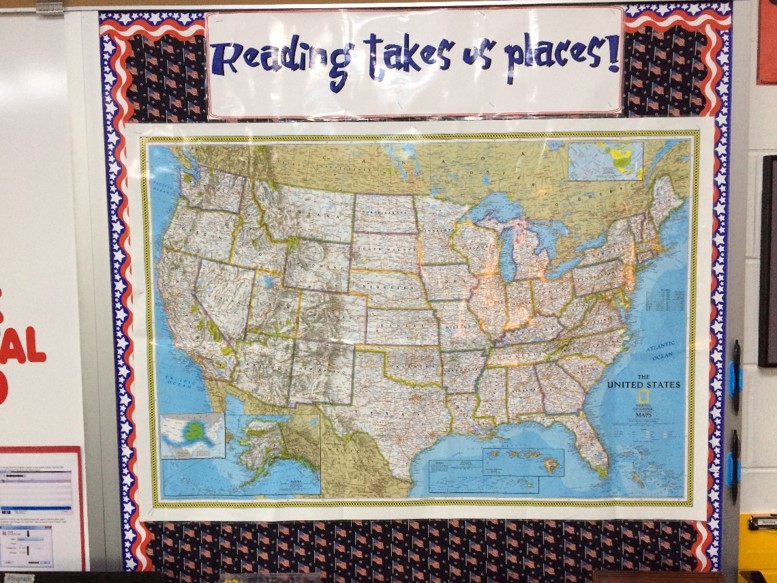
After getting all of my push pins organized in these fancy, but inexpensive, plastic bins, I put up my first interactive bulletin board. When the students arrived to school on Monday, they say the board that you see in the pictures below. When I explained to them that they each had their own colored push pin and would be able to pin the map when they read about a place in their books, they were all excited. Soon, I started noticing more and more students getting up, looking intently at the map, and pinning a place.
It was nice to see a bulletin board being used for something that helped students connect what they were reading to a map skills standard in which they struggled. Now, what will happen to me when a new student shows up and I need to find ANOTHER color? Oh, help me!
The “Reading Takes Us Places!” BoardThe twenty-four push pins!








 Adventures in Education